
Ever wondered what truly moves financial markets today? It’s not always human decisions.
Welcome to the world of High-Frequency Trading (HFT), where algorithms rule with lightning speed.
Quick Summary:
- ⚡️ HFT uses advanced computer programs for ultra-fast trading.
- 🔍 These algorithms exploit tiny price discrepancies across markets.
- 📊 HFT significantly impacts market liquidity and overall efficiency.
Understanding High-Frequency Trading
High-Frequency Trading, or HFT, is a sophisticated type of algorithmic trading.
It involves using powerful computers and complex algorithms to execute a massive number of orders at incredibly high speeds, often in fractions of a second. Think of it as the Formula 1 of the financial world.
What is High-Frequency Trading (HFT)?
At its core, HFT firms use proprietary algorithms to analyze market data and execute trades almost instantaneously.
Their goal is to capitalize on minuscule price differences or fleeting market opportunities that human traders simply cannot perceive or react to. This isn’t about deep analysis; it’s about pure speed.
The Need for Speed
In HFT, every millisecond counts. Firms invest heavily in technology to gain even the slightest time advantage.
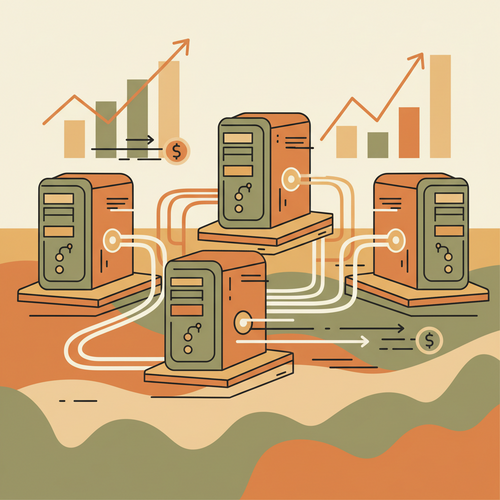
This includes ultra-low-latency data connections and placing their servers physically close to exchange matching engines, a practice known as “colocation.” Proximity is power in this game.
How HFT Algorithms Work
HFT algorithms employ various strategies, each designed to profit from rapid market movements.
One common strategy is arbitrage, where algorithms buy and sell the same asset on different exchanges to profit from tiny price differences. They are constantly seeking out these small inefficiencies.
- 🚀 Market Making: HFT firms act as market makers, simultaneously offering to buy (bid) and sell (ask) securities. This provides liquidity to the market and they profit from the “bid-ask spread.”
- 📊 Event Arbitrage: Algorithms react to news releases or economic data faster than human traders. They can place trades milliseconds after a major announcement, capturing quick profits.
- ⚡ Statistical Arbitrage: These strategies look for temporary price relationships between different securities. When these relationships diverge, algorithms trade to profit when they converge again.
Pros and Cons of HFT
HFT isn’t without its controversies, but it also brings significant benefits to markets.
On the positive side, it can lead to increased market liquidity, meaning it’s easier to buy or sell assets without significantly impacting their price. This makes markets more efficient for everyone.
However, critics point to increased market volatility and the potential for “flash crashes.” These are rapid, severe market declines that can happen and recover within minutes. The speed that brings efficiency can also bring instability.
⚠️ Warning: Not for Retail Investors
High-Frequency Trading is an institutional game. As a beginner, attempting to compete with HFT algorithms would be like bringing a bicycle to a Formula 1 race. Focus on long-term strategies, not speed. You simply don’t have the technology or capital.
Key Technologies Behind HFT
The backbone of HFT is cutting-edge technology. Without it, these firms simply couldn’t operate.
Fiber optic networks are engineered for minimal data transmission delays, often using specialized hardware. It’s about optimizing every single nanosecond.
Colocation is another critical factor. HFT servers are placed in data centers directly adjacent to stock exchange matching engines. This drastically reduces the time it takes for orders to travel.
| Feature | High-Frequency Trading | Traditional Trading |
|---|---|---|
| Time Horizon | Milliseconds to Seconds | Hours, Days, Weeks, Years |
| Order Volume | Millions per day | Dozens to Hundreds per day |
| Technology Focus | Speed, Low Latency, Algorithms | Research, Fundamental Analysis |
| Capital Required | Billions (institutional) | Varied (retail to institutional) |
| Primary Goal | Profit from tiny price shifts | Capital appreciation, dividends |
Impact on Market Structure
HFT has undeniably reshaped the landscape of financial markets.
It has intensified competition among market participants, forcing even traditional firms to adopt faster technologies. The old ways of trading are constantly being challenged.
In my experience, this means that retail investors often find it harder to get the best prices without specialized tools. HFT contributes significantly to price discovery, rapidly incorporating new information into asset prices. Markets react faster to news than ever before.
- 💸 Narrower Spreads: The difference between the buy and sell price (the spread) is often smaller due to HFT competition. This can subtly benefit all traders.
- 📈 Increased Liquidity: HFT often ensures there are always buyers and sellers available, making it easier to execute trades quickly.
- 📉 Market Efficiency: Prices adjust more quickly to new information, making markets generally more efficient.
- 👁️ Transparency Challenges: The complexity of HFT can make it difficult for regulators to monitor and understand all market activity.
Controversies and Regulations
The speed and opacity of HFT have led to significant regulatory scrutiny.
One major concern is “spoofing,” where traders place large orders with no intention of executing them, merely to trick other algorithms into moving prices. Such practices are highly illegal and disruptive.
Regulators like the SEC (https://www.sec.gov/) have introduced measures to curb abusive practices, including “kill switches” that can halt trading in extreme volatility. The aim is to maintain market integrity and fairness.
💡 Pro Tip: Focus on What You Can Control
Instead of trying to beat HFT, focus on your own investment strategy. Diversify your portfolio, understand your risk tolerance, and invest for the long term. These are the principles that truly build wealth, not chasing milliseconds.
Is HFT for You?
Let’s be clear: High-Frequency Trading is absolutely not for individual investors. It requires immense capital, specialized technology, and advanced quantitative skills.
Instead, understanding HFT helps you appreciate the underlying mechanics of modern markets. It impacts the prices you see and the liquidity available when you trade. Being informed is always a powerful tool.
- 👩💻 Highly Specialized: This field is dominated by physicists, mathematicians, and computer scientists.
- 💰 Massive Investment: Firms spend millions on hardware, software, and connectivity.
- ⚖️ Regulatory Scrutiny: The environment is constantly evolving due to new rules and enforcement.
- 🧠 Complex Strategies: The algorithms are incredibly intricate, far beyond simple trading rules.
The Future of HFT
The evolution of HFT shows no signs of slowing down.
Artificial intelligence and machine learning are increasingly integrated into HFT algorithms, allowing them to adapt and learn from market conditions in real-time. This makes them even more sophisticated and autonomous.
My prediction is that we’ll see further advancements in quantum computing research potentially affecting market speed, though that’s still distant. The relentless pursuit of speed and intelligent automation will define its future. It’s a never-ending technological arms race.
🛑 Warning: Don’t Confuse HFT with Day Trading
While both involve short-term strategies, HFT operates on an entirely different scale of speed and technology. Day trading, while risky, is done by individuals. HFT is purely institutional and algorithmic.
For more insights into global financial markets, I often check sources like https://www.bloomberg.com/ and https://www.wsj.com/ for their comprehensive coverage. Understanding the big picture is key.
Another excellent resource for market data and research is https://www.nasdaq.com/. They offer a wealth of information that can help you stay informed about market trends.
Conclusion
High-Frequency Trading is a powerful, often invisible force shaping modern financial markets.
It brings both incredible efficiency and unique challenges, operating at speeds unimaginable just a few decades ago. Algorithms now play a central role in how prices move and how liquidity is provided.
While HFT isn’t for the everyday investor, understanding its mechanics offers crucial insight into the highly technological world of finance. It highlights the constant evolution of market dynamics.
What are your thoughts on the impact of algorithms on financial markets? Do you think they make markets fairer or riskier?