
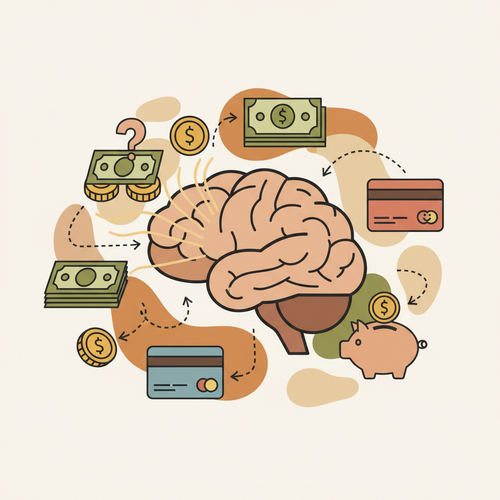
Have you ever wondered why you buy certain things, even when you know you shouldn’t? It’s not just about logical decisions; your mind plays powerful tricks on your wallet. Understanding these psychological triggers can revolutionize how you manage your money.
Quick Summary: Decoding Your Spending Habits
- 💡 Emotions often drive financial choices more than pure logic, leading to impulse buys.
- 🧠 Behavioral biases, like anchoring and social proof, heavily influence what and how we spend.
- 🚀 You can reprogram your spending habits by understanding these triggers and implementing mindful strategies.
Understanding Your Money Brain
Your relationship with money is deeply personal, shaped by your experiences and beliefs. We often make financial choices based on ingrained patterns rather than careful calculation. This unconscious behavior is what “the psychology of money” aims to unravel for you.
Emotional vs. Logical Spending
Think about your last impulse purchase. Did you really need it, or did it just *feel* good to buy? Many of our spending decisions are fueled by emotions like joy, fear, or a desire for status. It’s easy to get caught up in the moment.
However, truly understanding your finances requires a more rational approach. Learning to pause before a purchase can create a vital buffer between emotion and action. This small habit can save you significant money over time.
Pro Tip: The 24-Hour Rule
For any non-essential purchase over a certain amount (e.g., $50), wait 24 hours before buying. This cooling-off period often reveals if it’s a true need or just an impulse.
I’ve seen countless individuals regret purchases made in haste. Taking a moment to reflect on your true needs is a powerful skill. It helps you prioritize what truly matters for your financial well-being.
The Influence of Social Proof
Are your friends buying new gadgets, or your colleagues flaunting expensive vacations? Social proof is a powerful psychological phenomenon that makes us want what others have. We often feel pressure to keep up with perceived norms.
This desire for belonging can lead to significant overspending. Comparing yourself to others is a common trap that depletes savings and creates unnecessary debt. Your financial journey is unique, not a competition.
- 🛍️ Marketing Tactics: Advertisers use “best-sellers” and “customer favorites” to trigger social proof.
- 👥 Peer Pressure: Seeing friends or family spend freely can make you feel deprived if you don’t.
- 📈 Fear of Missing Out (FOMO): The anxiety that you’re missing out on desirable experiences or products.
In my experience, the biggest mistake beginners make is letting external pressures dictate their internal financial peace. Focus on your own goals, not someone else’s highlight reel. Read more about financial trends on Bloomberg.
Behavioral Biases at Play
Our brains are wired with various biases that affect how we perceive value and risk. Anchoring, for example, is when we rely too heavily on the first piece of information offered. A “was $1000, now $500” tag makes $500 seem like a steal, regardless of its actual worth.
Another bias is loss aversion – the pain of losing something feels stronger than the pleasure of gaining an equivalent item. This often makes us hold onto bad investments or avoid taking necessary financial risks. You’re not alone if you’ve felt this.
| Bias Type | How It Affects Spending | Strategy to Counter |
|---|---|---|
| Anchoring | Overpaying based on initial, high price comparisons. | Research true market value independently. |
| Framing | Choosing options based on how they’re presented (e.g., “save $10” vs. “lose $10”). | Always evaluate the objective facts, not just the presentation. |
| Loss Aversion | Holding onto depreciating assets, avoiding potentially good investments. | Focus on future potential, not just past losses. |
These biases are powerful, but recognizing them is the first step towards smarter spending. It allows you to consciously challenge your automatic reactions. You gain control over your financial narrative. Explore more financial insights on Forbes.
The Power of Scarcity and Urgency
“Limited time offer!” “Only 3 left in stock!” These phrases trigger a primal fear of missing out. Scarcity and urgency are potent psychological tools used by marketers to accelerate your buying decision. They bypass rational thought.
When you feel pressured, your brain shifts into a reactive mode. This reduces your ability to critically assess whether the purchase aligns with your financial goals. It’s a classic sales tactic for a reason: it works effectively.
Warning: Don’t Fall for False Urgency
Always question deadlines and “limited availability.” Often, these are artificial constructs designed to make you act without thinking. Most good deals will come around again or be replaced by something similar.
I’ve learned that true value doesn’t need a ticking clock. Take a breath, step back, and evaluate the offer on its merits, not its manufactured scarcity. This discipline is crucial for protecting your wallet. Deep dive into financial education at Investopedia.
Building Better Money Habits
Now that you understand *why* you spend, let’s talk about *how* to change it. Building better money habits isn’t about deprivation; it’s about conscious control. It’s about aligning your spending with your values.
Start with a simple budget. Knowing where your money goes is the foundational step to taking command of it. This visibility empowers you to make informed decisions. Many free tools can help you get started.
- 📝 Track Your Spending: Use apps or a spreadsheet to see every dollar’s destination.
- 🎯 Set Clear Goals: What are you saving for? A house, retirement, a trip? Specific goals motivate you.
- 🚫 Automate Savings: Set up automatic transfers to your savings account right after payday.
- 🙏 Practice Delayed Gratification: Resist immediate urges for larger future rewards.
In my personal journey, automating my savings was a game-changer for building consistent wealth. It removes the decision-making friction, making saving effortless. Discover more about personal finance in the New York Times.
Remember, financial mindfulness is a marathon, not a sprint. Be patient with yourself as you learn to recognize and overcome these psychological traps. Every small step forward builds momentum. Get financial news from The Wall Street Journal.
Conclusion
The psychology of money reveals that our spending is rarely purely rational. Emotions, social pressures, and cognitive biases all play significant roles in our financial decisions. By understanding these underlying mechanisms, you gain incredible power over your financial future.
What is one new money habit you will commit to starting this week to align your spending with your goals?