
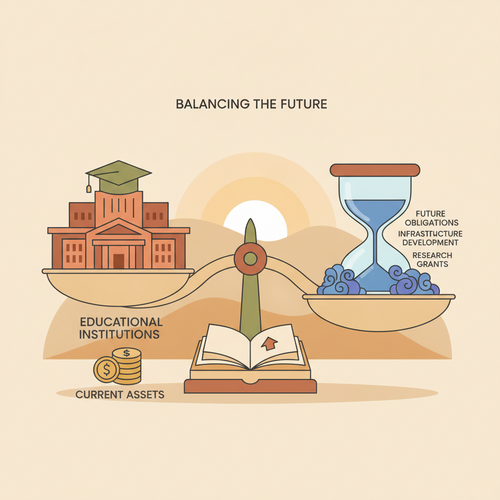
Executive Summary
- Educational liability hedging strategically mitigates profound long-term financial exposures for academic institutions.
- Strategic deferment protocols optimize capital deployment and ensure vital intergenerational equity in resource allocation.
- Actuarial risk transfer mechanisms offload significant, volatile future obligations, enhancing fiscal resilience.
The Imperative of Educational Liability Hedging
Educational institutions face profound, long-duration liabilities. These obligations extend far beyond immediate operational costs. They encompass multi-decade pension commitments, post-retirement healthcare benefits, and future tuition revenue uncertainties. Prudent financial stewardship demands proactive mitigation strategies to safeguard institutional longevity.
Unhedged liabilities expose institutions to severe market volatility. Interest rate shifts, demographic changes, and inflationary pressures directly impact future solvency. A robust hedging framework ensures institutional resilience and preserves the core academic mission effectively.
Deconstructing Strategic Deferment Protocols
Strategic deferment involves consciously postponing or reallocating financial obligations. This is not mere procrastination. It represents an actuarially sound approach to sophisticated liability management. Institutions leverage the time value of money principles to their long-term advantage.
Key mechanisms include rigorously defined endowment spending rules and optimized debt structuring. These protocols aim to smooth expenditure impacts over extended periods. They ensure intergenerational equity, preventing an undue financial burden on future cohorts of students and faculty.
- Endowment Payout Smoothing: Institutions implement formulas averaging endowment returns over multiple years. This methodology stabilizes distributions during pronounced market downturns. It protects the core endowment principal from short-term volatility.
- Revenue Bond Deferment: Issuing long-dated revenue bonds effectively defers principal repayment. Institutions utilize current revenues primarily for mission-critical academic programs. This strategy necessitates careful covenant management and robust credit ratings.
- Tuition Guarantee Programs: Offering fixed tuition plans for incoming cohorts transfers some inflation risk to the institution. Actuarial modeling becomes absolutely critical for pricing these complex guarantees accurately and sustainably.
Dynamic Asset-Liability Matching (ALM) Frameworks
Effective deferment protocols integrate robust Asset-Liability Matching (ALM). This involves meticulously aligning asset durations with their corresponding liability profiles. Mismatches can create significant financial vulnerabilities, exposing institutions to unnecessary risk. ALM optimizes portfolio construction against future obligations.
Institutions employ sophisticated fixed-income portfolios tailored to their specific needs. These portfolios aim to mirror the precise cash flow characteristics of their liabilities. Duration matching minimizes interest rate sensitivity across the institution’s entire balance sheet, providing stability.
Actuarial Risk Transfer Mechanisms in Practice
Actuarial risk transfer shifts specific, measurable, and often complex risks to third parties. Insurance companies and specialized financial markets serve as primary counterparties. This externalization significantly reduces an institution’s direct exposure to adverse or unpredictable events.
Common transfer methods involve highly specialized insurance policies. These can cover longevity risk associated with pensions or certain investment performance shortfalls. Derivatives contracts also play a significant role in managing specific, identifiable market risks efficiently.
Expert Insight: “The intricate complexity of higher education’s financial ecosystem necessitates innovative risk transfer solutions. Traditional general liability insurance often proves insufficient for highly specific, long-term actuarial exposures like faculty pension liabilities or post-retirement benefits.”
Pension Longevity Swaps and Buy-Ins
Defined benefit pension plans represent substantial longevity risk. Pensioners living longer than actuarial expectations directly increase plan costs significantly. Longevity swaps are financial instruments that transfer this specific risk to an insurer or reinsurer for a premium.
A pension buy-in involves an institution purchasing an annuity policy from an insurer. This policy covers a specific, identified portion of its overall pension liabilities. The institution retains plan sponsorship but offloads investment and longevity risk for the covered group, streamlining management.
Conversely, a pension buy-out transfers the entire pension obligation to an insurer. This permanently removes the liability completely from the institution’s balance sheet. It is a more permanent, albeit often costlier, solution offering definitive closure to pension risks.
Contingent Capital and Synthetic Hedges
Contingent capital provides pre-arranged funding in specific, predefined adverse scenarios. This acts as a crucial liquidity backstop without incurring immediate costs. It is a highly effective form of risk transfer designed for extreme, low-probability, high-impact events.
Synthetic hedges primarily utilize advanced financial derivatives. Interest rate swaps, for example, transform floating-rate debt into predictable fixed-rate obligations. This mitigates exposure to potentially rising interest rates on an institution’s variable-rate bond portfolio, stabilizing debt service.
Macroeconomic Influences on Liability Management
External economic factors profoundly impact institutional liability hedging strategies. Persistent inflation erodes the purchasing power of future fixed payments, increasing real costs. Interest rate changes directly affect the discounted present value of all future liabilities, altering their perceived burden.
Demographic shifts, particularly declining birth rates and changing student preferences, impact future tuition revenue streams significantly. This long-term pressure can exacerbate existing liability challenges. Institutions must model these macroeconomic scenarios rigorously and adapt proactively.
- Inflationary Pressures: Higher inflation invariably increases operational costs and employee compensation demands. Defined benefit plans often include inflation-linked adjustments. This necessitates inflation-protected asset allocations within endowment portfolios to maintain real value.
- Interest Rate Environment: A persistently low interest rate environment increases the present value of future liabilities, making them appear larger. This makes effective hedging more expensive and challenging. Institutions seek higher-yielding, creditworthy investments to close funding gaps.
- Regulatory Frameworks: Evolving accounting standards (e.g., FASB, GASB) and pension regulations (e.g., ERISA guidelines for private institutions) significantly influence strategy. Compliance costs and stringent reporting requirements can be substantial. Proactive adaptation and legal counsel are essential.
Implementation Challenges and Mitigation Strategies
Implementing sophisticated liability hedging frameworks is not without significant hurdles. Data quality and actuarial modeling precision are paramount. Inadequate or inaccurate data can lead to suboptimal or even erroneous hedging decisions, creating new risks.
Institutional governance structures must explicitly support long-term strategies. Short-term budget cycles often conflict directly with multi-decade liability horizons, creating internal friction. Strong leadership, clear mandates, and cross-functional collaboration are essential for success.
Market Warning: “Over-reliance on complex derivatives or intricate actuarial models without robust internal expertise can paradoxically amplify risks rather than mitigate them. Transparency, rigorous stress testing, and independent validation are non-negotiable for effective risk transfer protocols.”
Mitigation strategies involve investing heavily in advanced analytics capabilities and specialized personnel. Collaborating with specialist external actuarial and financial advisors provides critical, unbiased expertise. Regular, independent audits validate model assumptions, strategy effectiveness, and compliance with best practices.
Building a pervasive culture of long-term financial planning is also crucial. This transcends individual administrative tenures and political shifts. It ensures continuity and consistent, disciplined application of deferment protocols and hedging strategies over time.
Advanced Strategies and Future Outlook
Forward-thinking institutions actively explore innovative hedging solutions tailored to their unique risk profiles. These include bespoke insurance products for specific, emerging educational risks, such as cybersecurity breaches with long-term financial ramifications. Climate change adaptation costs are also rapidly emerging as new, significant long-term liabilities.
Integrating environmental, social, and governance (ESG) factors into comprehensive ALM is gaining substantial traction. Sustainable investment practices can often align positively with long-term liability profiles and stakeholder values. This integrated approach increasingly attracts responsible capital and enhances institutional reputation.
Digital transformation offers powerful new tools for liability management. Predictive analytics, machine learning, and artificial intelligence can significantly enhance actuarial forecasting capabilities. These technologies provide more granular and accurate insights into future obligations and potential hedging effectiveness.
Institutions must also consider the evolving landscape of student debt and government policy. Indirect liabilities related to student loan defaults or changes in federal funding models may emerge. This necessitates a broader, more comprehensive interpretation of “educational liabilities” going forward.
Explore educational endowment principles and management on Investopedia.
Understand actuarial science methodologies and applications on Investopedia.
Conclusion
Effective educational liability hedging is absolutely indispensable. It protects long-term institutional financial health comprehensively. Strategic deferment protocols optimize critical capital resources with maximum efficiency. Actuarial risk transfer mechanisms offload significant, complex financial exposures. These integrated approaches ensure enduring institutional financial solvency. They decisively preserve an institution’s core academic mission for future generations. Are your institution’s long-term liabilities adequately hedged against inevitable future economic volatility and demographic shifts?