
Executive Summary
- Educational tranche securitization reorganizes raw student loan debt into segmented investment vehicles tailored for diverse risk appetites.
- Senior structures offer prime investment-grade stability, whereas subordinate tranches capture higher yield through credit risk absorption.
- Advanced credit enhancements and cash flow waterfall mechanics protect senior investors against default spikes and prepayment volatility.
Understanding the Architecture of Educational Asset-Backed Securities
Student Loan Asset-Backed Securities (SLABS) represent a major segment of structured finance. These capital instruments pool individual student obligations into tradeable fixed-income securities. Originators package private education loans, refinancing loans, and income-share agreements into unified collateral pools. Investors then acquire exposure to recurring consumer debt service payments.
The primary underlying asset base varies significantly across issuing institutions. Federal student loans benefit from explicit or implicit government guarantees. In contrast, private student debt depends entirely on borrower creditworthiness and cosigner backing. Modern issuers also package Income Share Agreements (ISAs). These contracts tie repayment obligations directly to future graduate income levels.
Structuring these obligations requires deep analysis of cash flow timing. Student loans exhibit unique payment phases. Borrowers often experience extended deferment and forbearance periods during academic enrollment. Consequently, structural cash flow modeling must account for delayed principal amortization. Accurate projection of these liquidity phases dictates final security pricing.
Tranching Mechanics: Balancing Risk and Return Profiles
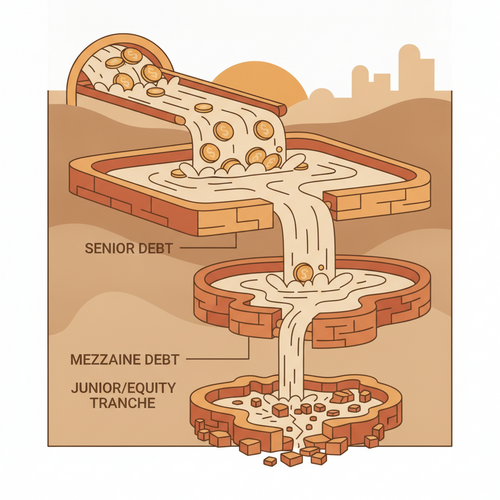
Tranching divides the aggregate risk of an asset pool into distinct payment tiers. Capital managers structure these tiers to appeal to varied institutional mandates. The standard waterfall mechanism dictates the precise order of interest and principal distributions. Cash flow priority flows strictly from top-tier senior claims down to junior equity slices.
Senior tranches occupy the highest position in the capital stack. These securities receive preferential liquidity distributions and maintain prime rating agency designations. Consequently, senior notes yield lower interest spreads over base reference rates. Insurers and conservative pension funds frequently purchase senior educational debt obligations.
Subordinated tranches absorb initial credit losses before senior classes suffer principal impairment. Mezzanine notes offer intermediate yield profiles with moderate loss protection. Conversely, equity or first-loss tranches capture residual cash flows. Equity investors accept substantial default risk in exchange for maximum yield potential. This hierarchical structure balances total risk across the investor base.
Structuring Yield Dynamics Across Tranche Classes
Yield generation in educational securitization depends on precise waterfall design. Structurers calculate yield spreads based on expected loss distribution curves. They analyze historical loss severity, default timing, and recovery rates across borrower cohorts. Higher credit risk exposure translates directly into wider contractual coupon spreads.
Prepayment behavior significantly alters expected yield profiles for fixed-income investors. Student loan borrowers often refinance debt when market interest rates decline. Rapid prepayments reduce the Weighted Average Life (WAL) of senior note classes. Conversely, slow prepayments extend duration risk during rising rate environments. Structurers utilize paydown rules to mitigate duration instability.
Interest rate benchmark shifts also influence floating-rate educational tranche structures. The transition from LIBOR to the Secured Overnight Financing Rate (SOFR) altered coupon calculations. Structurers install interest rate caps and floors to stabilize yield volatility. These derivative overlays protect noteholders from adverse benchmark fluctuations.
Comparative Risk-Return Matrix Across Tranche Structures
The table below summarizes the key financial metrics across primary educational tranche categories.
| Tranche Class | Target Credit Rating | Yield Premium (Spread over SOFR) | Loss Absorption Order | Primary Investor Profile |
|---|---|---|---|---|
| Senior (Class A) | AAA / Aaa | 100 – 150 bps | Final (Highest Protection) | Pension Funds, Insurance Companies |
| Mezzanine (Class B) | A / BBB | 200 – 350 bps | Intermediate | Asset Managers, Specialized Funds |
| Subordinated (Class C) | BB / B | 450 – 650 bps | First-Loss Buffer | Hedge Funds, Family Offices |
| Residual / Equity | Unrated | Variable (1000+ bps target) | Initial (First Dollar Loss) | Originators, Private Equity |
Credit Enhancement Mechanisms in Student Loan Securitization
Credit enhancements fortify tranche ratings against unexpected collateral defaults. Issuers combine internal structural features with external financial protections. These mechanics shield senior investors from baseline pool performance degradation. Robust enhancement design remains essential for achieving investment-grade credit ratings.
Overcollateralization serves as a foundational internal credit enhancement. Originators contribute collateral value exceeding the total principal face value of issued notes. For example, a $105 million loan pool may back $100 million in debt notes. The $5 million excess collateral cushions initial portfolio principal losses.
Excess spread represents another primary internal defensive layer. This metric measures the gap between collateral interest collection and tranche interest payouts. Originators route remaining net interest income into dedicated reserve accounts. These cash reserve accounts fund shortfalls during high-default stress cycles. Additionally, third-party surety bonds provide external guarantee options for selected structures.
Performance Drivers and Macroeconomic Sensitivity Factors
Macroeconomic variables exert direct pressure on student loan repayment velocity. National unemployment levels strongly correlate with default rates among recent college graduates. Economic downturns reduce entry-level wage growth across major professional sectors. Reduced borrower disposable income directly impairs debt service coverage ratios.
Institutional accreditation and graduate career placement rates heavily influence pool performance. High-tier university cohorts consistently demonstrate lower default rates than unaccredited trade programs. Modern securitization models incorporate institutional quality metrics into collateral scoring. Originators adjust tranche sizing based on school selectivity and graduation statistics.
Regulatory policy shifts represent significant systemic risks for yield investors. Federal student debt forgiveness initiatives introduce structural uncertainty regarding prepayment speeds. Legislative changes altering bankruptcy dischargeability also impact underlying recovery assumptions. Investors require higher yields to compensate for regulatory policy unpredictability.
Underwriting Optimization and Predictive Cash Flow Modeling
Advanced asset evaluation relies on predictive machine learning algorithms. Structurers analyze millions of historical loan performance data points. They evaluate FICO score distributions, cosigner availability, and geographic concentration risk. Machine learning models identify subtle credit performance correlations across diverse borrower segments.
Income Share Agreement (Securitization) structures demand unique modeling frameworks. Unlike fixed-rate installment loans, ISA cash flows fluctuate with graduate earnings. Actuaries model potential career trajectories and sector wage inflation patterns. They project cash distributions using stochastic simulations of future income distributions.
Stress testing frameworks simulate extreme economic shocks on cash flow waterfalls. Models apply severe default spikes and prolonged macroeconomic stagnation scenarios. Structurers test whether senior tranches maintain uninterrupted interest payments under stress conditions. This quantitative rigor ensures structural resilience against black swan financial events.
Servicing Efficiency and Operational Risk Management in SLABS
Loan servicing operational performance directly impacts portfolio cash flow efficiency. Loan servicers handle payment processing, borrower deferments, and default remediation efforts. Inefficient servicing protocols increase loan delinquency rates and elevate administrative costs. Structured transactions establish strict key performance indicators for primary servicing entities.
Backup servicing agreements protect bondholders against primary servicer insolvency or operational failure. Named backup servicers maintain continuous data synchronization with primary operators. In the event of a servicer default, the backup entity assumes operational control quickly. This operational redundancy minimizes cash flow disruptions across all tranche tiers.
Specialized default management strategies mitigate net loss severity within underlying loan pools. Servicers utilize automated borrower engagement tools and flexible repayment restructurings. Early intervention protocols prevent short-term delinquencies from escalating into permanent defaults. Effective servicing execution directly enhances total portfolio net excess spread.
Regulatory Compliance and Disclosure Standards in Student Debt Markets
Regulatory scrutiny surrounds student loan origination and debt collection practices. Issuers must strictly comply with federal truth-in-lending disclosure rules and state licensing laws. Non-compliance can invalidate underlying borrower contracts and impair pool cash flows. Due diligence teams verify regulatory adherence before pool closing.
Enhanced reporting standards improve transparency for institutional note buyers. Issuers provide monthly loan-level performance data, delinquency roll rates, and loss coverage metrics. Transparent reporting allows investors to track collateral performance against initial baseline expectations. Clear disclosures reduce information asymmetry across primary and secondary asset markets.
Environmental, Social, and Governance (ESG) frameworks increasingly shape educational debt securitization. Investors evaluate the social impact of student loan pricing and borrowing terms. Responsible lending criteria promote sustainable educational funding access without predatory cost structures. ESG-aligned tranche offerings attract dedicated green and social capital funds.
Institutional Investor Allocation Strategies in Current Yield Regimes
Institutional investors utilize educational tranche securitization products to enhance fixed-income portfolio returns. Senior educational notes provide defensive yield superiority compared to similarly rated corporate debt. Institutional buyers capture attractive risk-adjusted spreads while maintaining strict liquidity mandates.
Alternative asset managers deploy capital into junior and mezzanine tranche structures. High-yield funds seek double-digit return targets by absorbing first-loss risk position layers. These managers actively monitor loan servicer performance and collection efficiency. Direct servicer engagement helps preserve net asset values across high-yield tranches.
Liability-driven investors align tranche duration profiles with long-term obligation timelines. Life insurance companies purchase long-dated student loan tranches to match extended payout liabilities. The predictable cash flow tail of structured education obligations fits liability-matching mandates. Custom tranche engineering continues to expand institutional participation in education debt markets.
Conclusion
Educational tranche securitization transforms raw student loan obligations into tailored financial instruments. Structurers effectively reallocate credit risk across specialized investor tiers.
Senior notes deliver reliable income and robust capital preservation. Meanwhile, subordinate classes provide elevated yield potential for risk-tolerant institutions.
Macroeconomic trends, underwriting standards, and structural credit enhancements dictate long-term tranche performance. Modern modeling techniques continue to refine cash flow predictive accuracy.
Are your structured fixed-income portfolios positioned to capitalize on evolving yield opportunities within educational debt markets?