
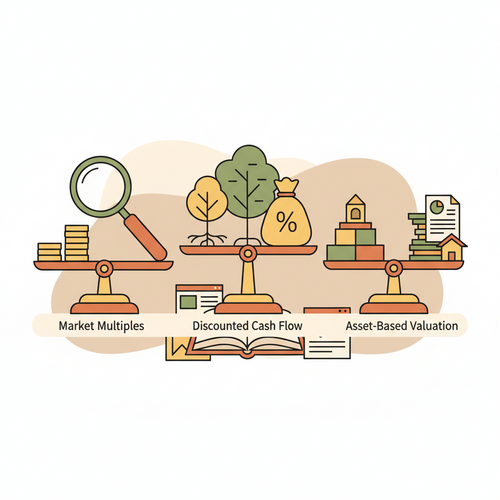
Understanding Corporate Valuation Methods is absolutely crucial for any beginner investor aiming to make informed decisions in the stock market. Indeed, valuing a company means determining its intrinsic worth. Therefore, investors can identify whether a stock is overvalued or undervalued. This process forms the bedrock of fundamental analysis. Furthermore, it helps in understanding a company’s financial health and future prospects.
What is Corporate Valuation?
Corporate valuation is essentially the process of determining the economic value of an entire company. Specifically, it involves analyzing a business, its assets, liabilities, and future earnings potential. The ultimate goal is to arrive at a single number representing what the company is truly worth. Consequently, this estimated value can then be compared against its current market price. This comparison reveals potential investment opportunities.
Why is Corporate Valuation Important for Investors?
For beginner investors, grasping valuation concepts is incredibly empowering. First, it allows you to invest with conviction. Instead of blindly following trends, you can assess a company’s true value. Furthermore, valuation helps in managing risk. Paying too much for a company inherently increases your investment risk. Conversely, finding undervalued companies can lead to significant returns.
- Informed Decisions: It provides a rational basis for buying or selling stocks.
- Risk Management: It prevents overpaying, thus protecting your capital.
- Opportunity Identification: You can spot companies trading below their true worth.
- Strategic Planning: It offers insights into a company’s financial structure and future growth.
Key Corporate Valuation Methods
There are several prominent approaches to valuing a company. Each method offers a unique perspective. Therefore, understanding multiple techniques provides a more comprehensive view. We will explore the most common ones suitable for beginner investors.
1. Discounted Cash Flow (DCF) Valuation
The Discounted Cash Flow (DCF) method is perhaps the most fundamental approach. Specifically, it values a company based on its projected future cash flows. These future cash flows are then “discounted” back to their present value. This accounts for the time value of money. Therefore, a dollar received today is worth more than a dollar received tomorrow. Investopedia offers great resources on this topic.
How DCF Works:
- Project Free Cash Flows (FCF): Estimate the cash a company expects to generate in the future. These are typically projected for 5-10 years.
- Determine the Discount Rate: This rate reflects the risk of the cash flows. Often, the Weighted Average Cost of Capital (WACC) is used.
- Calculate Terminal Value: This represents the value of all cash flows beyond the initial projection period.
- Sum Present Values: All projected FCFs and the terminal value are discounted to their present value. Their sum equals the company’s intrinsic value.
Advantages and Disadvantages:
- Pros: It is theoretically sound and focuses on intrinsic value. Indeed, it forces a deep understanding of the company’s operations.
- Cons: It relies heavily on assumptions. Therefore, small changes in inputs can significantly alter the valuation.
2. Relative Valuation (Comparable Company Analysis)
Relative valuation involves comparing a company to similar businesses or assets. Specifically, it uses financial multiples or ratios to gauge value. For instance, if comparable companies trade at a certain price-to-earnings (P/E) ratio, your target company might be valued similarly. This method provides market-based insights. Therefore, it is often easier to apply than DCF. Reuters often reports on market multiples.
Common Multiples Used:
- Price-to-Earnings (P/E) Ratio: Compares share price to earnings per share.
- Enterprise Value to EBITDA (EV/EBITDA): Measures a company’s total value against its earnings before interest, taxes, depreciation, and amortization.
- Price-to-Sales (P/S) Ratio: Useful for companies with low or negative earnings.
- Price-to-Book (P/B) Ratio: Compares market value to book value.
Advantages and Disadvantages:
- Pros: It is straightforward and reflects current market sentiment. Furthermore, it is relatively easy to understand.
- Cons: Finding truly comparable companies can be challenging. Also, market sentiment can sometimes be irrational.
3. Asset-Based Valuation
Asset-based valuation determines a company’s value by summing the fair market value of its assets. Subsequently, liabilities are subtracted from this total. This method is particularly useful for companies with significant tangible assets. For instance, real estate companies or manufacturing firms often utilize this approach. However, valuing intangible assets presents challenges.
When to Use It:
- Liquidation Scenarios: It helps determine the value if a company were to be sold off in pieces.
- Capital-Intensive Industries: Industries with substantial physical assets benefit from this method.
- New or Struggling Companies: When future cash flows are highly uncertain, asset value provides a floor.
Challenges:
- Valuing intangible assets like brand name or intellectual property is difficult.
- Market values for certain assets can be hard to ascertain accurately.
4. Precedent Transactions Analysis
Precedent transactions analysis involves valuing a company by looking at the prices paid for similar companies in past mergers and acquisitions (M&A) deals. Therefore, it provides insights into what strategic buyers have been willing to pay. This method reflects control premiums and synergies expected in M&A. Consequently, it can yield higher valuations than other methods. The Wall Street Journal frequently covers M&A news.
How It Works:
- Identify Comparable Transactions: Search for M&A deals involving companies similar in industry, size, and geography.
- Analyze Transaction Multiples: Extract valuation multiples from these deals (e.g., EV/EBITDA paid, P/E paid).
- Apply Multiples: Apply these multiples to the financial metrics of the target company.
Considerations:
- Market conditions at the time of the precedent deal can influence results.
- Finding truly comparable transactions can be difficult.
- The specific strategic rationale behind each historical deal impacts the price paid.
Choosing the Right Valuation Method
Indeed, no single valuation method is universally superior. The “best” approach often depends on the specific company, industry, and available data. Therefore, experienced investors typically use a combination of methods. This triangulation helps to validate findings. For instance, a DCF might provide a theoretical intrinsic value. Then, relative valuation can ground that value in current market realities. Bloomberg often presents valuation ranges using multiple models.
- Industry Specifics: Some industries lend themselves better to certain methods.
- Company Stage: Mature, stable companies are good for DCF. Startups might require more creative approaches.
- Data Availability: The richness and reliability of financial data significantly impact method choice.
Limitations and Considerations
While powerful, corporate valuation is not an exact science. Many assumptions are inherent in these models. Therefore, the output is only as good as the inputs. Beginner investors must remain aware of these limitations. Furthermore, always conduct thorough due diligence. Relying solely on a model without understanding the underlying business is risky. Forbes often highlights the nuances of financial analysis.
- Subjectivity: Assumptions about growth rates, discount rates, and future performance are subjective.
- Market Volatility: External market factors can impact stock prices irrespective of intrinsic value.
- Data Quality: The accuracy of financial data is paramount.
- Future Uncertainty: Predicting the future is inherently difficult, introducing variability into projections.
Conclusion
In conclusion, mastering Corporate Valuation Methods is a vital skill for any successful investor. These methods provide a structured framework for analyzing companies. Specifically, they move you beyond speculation to informed decision-making. Whether you choose DCF, relative valuation, asset-based, or precedent transactions, understanding their nuances is key. Remember, valuation is an art as much as a science. Practice, critical thinking, and continuous learning will undoubtedly refine your skills. Therefore, start exploring these powerful tools today to unlock better investment outcomes.