
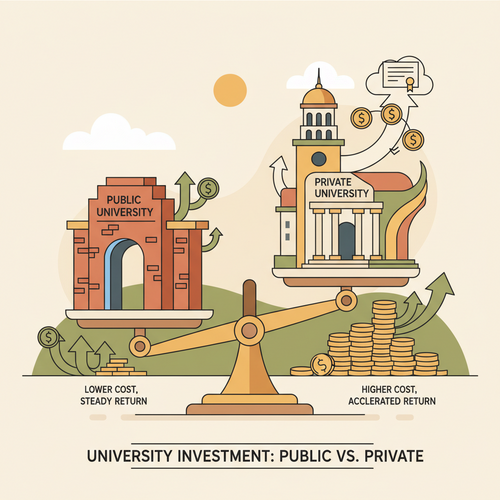
The decision between Public Ivies vs. Private Universities represents a pivotal moment for aspiring students and their families. This choice extends far beyond academic programs; it deeply impacts financial futures, long-term career prospects, and overall educational value. Navigating the complex landscape of higher education costs requires careful consideration, especially regarding tuition expenses and the elusive, yet critical, return on investment (ROI).
Understanding the nuances of these two distinct educational paths is paramount. Many assume private institutions always carry a heftier price tag, while public universities offer an inherently cheaper alternative. However, the reality is often more intricate. This detailed guide meticulously compares these options, offering clarity on financial implications and potential benefits.
Public Ivies vs. Private Universities: Understanding the Landscape of Higher Education
Selecting the right university involves balancing numerous factors. Academic reputation, campus culture, location, and program availability all play significant roles. Crucially, the financial aspect frequently emerges as a primary concern. Both public and private universities present unique advantages and disadvantages.
Public universities, funded primarily by state governments, typically aim to provide accessible education to state residents. Private universities, conversely, rely more heavily on tuition fees, endowments, and private donations. This fundamental difference in funding models directly influences their cost structures and, consequently, their accessibility.
The Allure of Public Ivies: A Prestigious Yet Affordable Path?
The term “Public Ivies” refers to a select group of public universities believed to provide a collegiate experience comparable to that of the Ivy League. These institutions combine rigorous academics with a vibrant campus life. Notably, they often achieve this without the exorbitant tuition associated with their private counterparts. Examples include the University of California system, the University of Michigan, and the University of Virginia.
Their appeal stems from a compelling blend of prestige and perceived affordability. Many prospective students view Public Ivies as an excellent value proposition. They offer strong academic programs, renowned faculty, and extensive alumni networks. Therefore, these institutions frequently attract top-tier students seeking a high-quality education at a more manageable cost. This combination makes them highly competitive.
Tuition Costs: A Deep Dive into Public vs. Private Institutions
Tuition remains the most significant component of college expenses for most families. Nevertheless, the advertised “sticker price” rarely tells the whole story. Prospective students must delve deeper into actual costs, considering various discounts and aid opportunities. This deeper analysis reveals substantial differences.
Comparing tuition requires more than just glancing at published rates. One must factor in residency status, financial aid packages, and other mandatory fees. Understanding these elements is essential for an accurate financial assessment.
Dissecting Public University Tuition: In-State vs. Out-of-State
Public universities employ a tiered tuition structure. In-state students typically benefit from significantly lower tuition rates. State governments subsidize these costs, aiming to keep higher education accessible for their residents. Consequently, attending a public university in your home state often represents a financially sound decision.
Conversely, out-of-state students face a substantially higher tuition bill. These rates can sometimes rival or even exceed those of private universities. For instance, a student from New York attending the University of California, Berkeley, will pay considerably more than a California resident. Therefore, out-of-state tuition can significantly diminish the “affordable” advantage traditionally associated with public institutions. Furthermore, mandatory fees for services, technology, and student activities invariably add to the total cost. These charges are often non-negotiable.
Understanding Private University Tuition: Sticker Price vs. Net Price
Private universities frequently display a dauntingly high sticker price for tuition, room, and board. These figures can easily reach $60,000 to $80,000 or more per year. Naturally, this often deters many families from even considering private options. However, this initial figure can be misleading.
The key lies in understanding the “net price.” This is the actual amount a student pays after subtracting grants, scholarships, and other forms of gift aid. Many private institutions possess large endowments, enabling them to offer generous financial aid packages. Consequently, a student attending a private university with a high sticker price might pay less out-of-pocket than an out-of-state student at a public university. Savvy families, therefore, prioritize the net price when evaluating affordability.
Return on Investment (ROI) in Higher Education: More Than Just a Price Tag
ROI in education gauges the financial benefits derived from a degree relative to its cost. It’s a critical metric for long-term financial planning. This goes beyond simply comparing starting salaries. A robust ROI considers career trajectory, earning potential over decades, and even personal fulfillment. For investors, it mirrors the expected returns on any significant capital outlay. A higher education degree is, undoubtedly, a significant investment.
Assessing educational ROI requires a holistic perspective. It incorporates both tangible monetary gains and intangible benefits like expanded networks and enhanced critical thinking skills. Thus, a comprehensive analysis is crucial for making informed decisions.
Factors Influencing Educational ROI: Beyond the Diploma
Several critical factors influence an education’s ROI. Firstly, the chosen field of study plays an enormous role. STEM (Science, Technology, Engineering, and Mathematics) degrees often lead to higher starting salaries and greater earning potential. Conversely, some humanities fields, while enriching, may offer lower immediate financial returns. Reuters often highlights these economic disparities in the job market.
Secondly, the reputation of the specific program or department within a university matters significantly. A highly-ranked engineering program at a public university might yield a better ROI than an average program at a private institution. Thirdly, the strength of the alumni network provides invaluable career connections and mentorship opportunities. Finally, geographical location and industry demand at the time of graduation further shape earning prospects. These factors collectively determine the financial yield of a degree.
Comparing Long-Term Value: Public Ivies and Private Institutions
Public Ivies often deliver an exceptional ROI, particularly for in-state students. Their combination of lower tuition and strong academic reputation means graduates can often secure well-paying jobs without significant student loan debt. This facilitates faster repayment and greater financial freedom post-graduation. Consequently, many Public Ivies consistently rank highly in analyses of educational value for money.
Private universities, despite their higher sticker prices, can also offer a compelling ROI. This is especially true for graduates from highly selective institutions with powerful alumni networks and strong career services. Investopedia frequently discusses how to calculate educational ROI, emphasizing both cost and future earnings. These universities often place graduates in high-paying sectors, leading to significant lifetime earnings. Moreover, specialized programs or niche expertise gained at certain private institutions can command a premium in the job market. The prestige associated with some private university degrees can open doors that might otherwise remain closed.
Financial Aid and Scholarships: Bridging the Affordability Gap
Financial aid fundamentally changes the equation when comparing college costs. It bridges the gap between the total cost of attendance and what families can realistically afford. Understanding the various types of aid and how to apply for them is crucial. Both public and private institutions offer distinct avenues for financial assistance, which significantly impacts the actual out-of-pocket expenses.
Many students mistakenly believe that private schools are always out of reach financially. However, comprehensive financial planning and strategic application for aid can make even the most expensive institutions surprisingly affordable. Therefore, never rule out an option based solely on its sticker price.
Navigating Financial Aid for Public Ivies
Public Ivies typically offer a range of financial aid options. These primarily include federal and state grants, federal student loans, and institutional scholarships. The Free Application for Federal Student Aid (FAFSA) serves as the gateway to most of these programs. Completing the FAFSA accurately and promptly is essential for determining eligibility for need-based aid.
Furthermore, many public universities offer merit-based scholarships, recognizing academic achievements or specific talents. These scholarships can significantly reduce the overall cost for high-achieving students, even for out-of-state applicants. However, competition for these awards can be fierce. Therefore, early application and a strong academic record are highly beneficial.
Unlocking Opportunities at Private Universities
Private universities are often renowned for their generous financial aid packages. Thanks to substantial endowments and donor contributions, many can meet a significant portion, or even 100%, of a student’s demonstrated financial need. This often takes the form of institutional grants and scholarships, which do not need to be repaid. The official StudentAid.gov website provides comprehensive information on federal aid programs applicable to both types of institutions.
Moreover, private institutions frequently offer merit scholarships designed to attract top students. These can be particularly impactful, reducing the net price considerably. Students with exceptional academic records, athletic prowess, or unique talents often find significant aid opportunities at private universities. Always inquire about specific scholarship programs directly with the financial aid office. Aggressively pursuing all available aid can dramatically alter the final cost.
Making an Informed Decision: Tailoring Your Educational Investment
Choosing between a Public Ivy and a private university is a deeply personal decision, influenced by individual circumstances, academic goals, and financial realities. There is no universally “better” option. Instead, the optimal choice depends on a thorough evaluation of personal priorities and a diligent assessment of value.
Prospective students should meticulously research specific programs, faculty expertise, and career services at each institution. Consider the overall campus environment and fit. Furthermore, calculate the net price for every school of interest, rather than relying on initial sticker prices. This diligent comparison illuminates the true financial commitment required.
Ultimately, the goal is to find an institution that offers a high-quality education aligning with career aspirations, all within a manageable budget. A strategic approach to college selection involves balancing academic ambition with financial prudence. This ensures a valuable educational experience without incurring excessive debt.
Conclusion
The debate of Public Ivies vs. Private Universities regarding tuition costs and ROI is multifaceted. Public Ivies often present an attractive proposition, especially for in-state students, offering high-quality education at a comparatively lower cost. This translates into a strong ROI for many graduates. Conversely, private universities, despite their high sticker prices, can become highly affordable through generous financial aid and merit scholarships. Their robust networks and specialized programs can also lead to excellent long-term career outcomes and a competitive ROI.
Therefore, the most prudent approach involves comprehensive research, diligent financial aid applications, and an honest assessment of individual needs and goals. Both types of institutions offer distinct pathways to success. Ultimately, a well-informed decision maximizes the return on one of life’s most significant investments: higher education.