
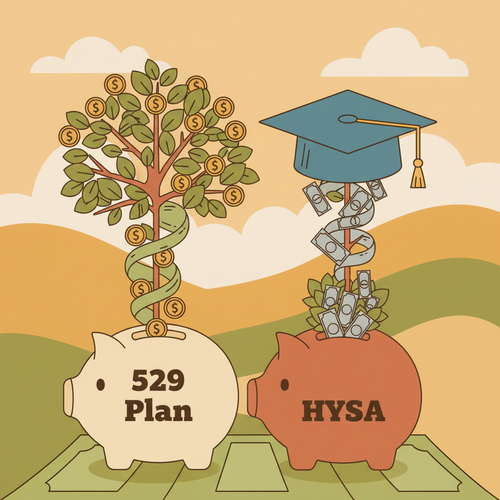
Saving for graduate school presents a significant financial undertaking. Many prospective students, therefore, diligently explore various investment vehicles. Consequently, two primary options frequently arise: 529 plans and high-yield savings accounts. Understanding their core distinctions is absolutely crucial. Indeed, each offers unique advantages and disadvantages for your advanced education goals.
Graduate school expenses extend far beyond tuition fees. For instance, consider the cost of living, textbooks, supplies, and technology. Furthermore, these costs continue to rise steadily. Therefore, developing a robust savings strategy becomes paramount. This article aims to clarify the benefits and drawbacks of both 529 plans and high-yield savings accounts. Ultimately, it will help you make an informed decision for your financial future.
Understanding Graduate School Costs
Before diving into savings vehicles, understanding the scope of graduate school expenses is vital. Tuition, of course, forms the largest component. However, many other costs quickly add up. For example, professional school programs like law or medicine often carry higher price tags. Moreover, living expenses can significantly impact your budget.
Specifically, room and board costs vary widely by location. Books and supplies also represent ongoing expenses. Furthermore, health insurance, transportation, and personal expenses must be factored in. Consequently, a comprehensive financial plan needs to account for all these elements. Indeed, neglecting any one aspect could lead to unexpected financial strain during your studies.
The Rising Price of Higher Education
The cost of graduate education has consistently increased over recent decades. This trend, therefore, necessitates proactive planning. Families and individuals must prepare for these escalating expenses. Moreover, securing a graduate degree often entails substantial student loan debt. Consequently, minimizing borrowing through strategic saving offers significant long-term benefits.
Indeed, understanding these financial realities is the first step. Afterward, you can properly evaluate which savings vehicle best suits your needs. Ultimately, your choice will depend on several factors. These include your timeline, risk tolerance, and certainty about attending graduate school.
What is a 529 Plan?
A 529 plan is a tax-advantaged savings plan. Specifically, it encourages saving for future education costs. Congress created these plans under Section 529 of the Internal Revenue Code. Therefore, they offer unique federal tax benefits. Many states also provide additional tax incentives. Typically, states sponsor these plans, but individuals can invest in any state’s plan.
Furthermore, 529 plans grow tax-deferred. Qualified withdrawals are also entirely tax-free. These qualified expenses encompass a broad range of costs. For instance, they include tuition, fees, books, supplies, and equipment. Room and board, provided the student attends at least half-time, also qualify. Increasingly, K-12 tuition and student loan repayment are also eligible.
Benefits of 529 Plans
One of the most significant advantages of a 529 plan is its tax treatment. Contributions grow without federal income tax on earnings. Subsequently, withdrawals for qualified educational expenses are also federal tax-free. Conversely, this differs greatly from taxable investment accounts.
- Tax-Free Growth and Withdrawals: Earnings in a 529 plan are not subject to federal income tax when used for qualified education expenses. Many states also offer state income tax deductions for contributions.
- High Contribution Limits: Individuals can contribute substantial amounts over time. These limits vary by state, often reaching hundreds of thousands of dollars.
- Flexibility: The account owner retains control of the funds. Furthermore, you can change the beneficiary to another eligible family member. This includes siblings, cousins, or even the account owner themselves.
- Investment Options: Most 529 plans offer various investment choices. For instance, age-based portfolios adjust risk levels as the beneficiary approaches college. Additionally, static portfolios provide fixed investment strategies.
- Estate Planning Benefits: Contributions to a 529 plan are considered completed gifts. Consequently, they reduce the contributor’s taxable estate. Furthermore, the account owner maintains control.
Drawbacks of 529 Plans
Despite their benefits, 529 plans also have limitations. Therefore, understanding these potential downsides is important. Specifically, funds must be used for qualified education expenses. Otherwise, penalties may apply.
- Non-Qualified Withdrawals: If funds are not used for qualified educational expenses, earnings become subject to federal income tax. Furthermore, a 10% federal penalty tax typically applies.
- Limited Investment Control: Investors generally choose from a selection of predetermined portfolios. Consequently, they do not have full control over individual stock or bond selections.
- Potential Impact on Financial Aid: Funds in a 529 plan are considered an asset of the account owner (usually the parent). Therefore, they typically have a relatively small impact on federal financial aid eligibility (assessed at 5.64%). However, they are not entirely disregarded.
- State-Specific Rules: While beneficial, state tax deductions are often only available for contributions to your home state’s plan. This can complicate choices for some investors.
What is a High-Yield Savings Account (HYSA)?
A high-yield savings account (HYSA) is a type of savings account. It typically offers a significantly higher interest rate than traditional savings accounts. These accounts are often found at online banks. Furthermore, they provide a secure place to store your money. Your principal is generally protected and earns interest over time.
Specifically, HYSAs are FDIC-insured up to $250,000 per depositor, per bank. This ensures your money’s safety. Therefore, they are considered a very low-risk option. Unlike investment accounts, HYSAs do not expose your principal to market fluctuations. Conversely, their returns are generally more modest.
Benefits of High-Yield Savings Accounts
HYSAs offer several compelling advantages. Specifically, they prioritize safety and accessibility. Therefore, they appeal to those seeking stability. Moreover, their liquidity is a key feature.
- Liquidity and Accessibility: Funds in an HYSA are readily accessible. You can easily withdraw money without penalties, typically via online transfers or ATM withdrawals. Consequently, this provides excellent flexibility.
- Safety and Security: HYSAs are FDIC-insured (for banks) or NCUA-insured (for credit unions). This guarantees the safety of your deposits up to federal limits. Indeed, market volatility does not affect your principal.
- No Risk of Loss: Unlike investments, HYSAs do not carry market risk. Your principal remains stable. Furthermore, you are guaranteed to earn the stated interest rate.
- No Restrictions on Use: You can use the money for any purpose. There are no limitations on how you spend the funds. Therefore, it offers complete financial freedom.
- Simplicity: Opening and managing an HYSA is straightforward. It requires minimal financial expertise. Consequently, it is an ideal option for beginner investors.
Drawbacks of High-Yield Savings Accounts
While safe, HYSAs also have limitations. Their primary drawback relates to growth potential. Therefore, they may not keep pace with inflation over the long term. Moreover, interest earned is taxable.
- Taxable Interest: The interest earned on an HYSA is considered ordinary income. Consequently, it is subject to federal and state income taxes. This reduces your net return.
- Lower Growth Potential: HYSAs generally offer lower returns compared to diversified investment portfolios. They are designed for capital preservation, not aggressive growth. Therefore, they may struggle to keep pace with tuition inflation.
- Interest Rates Fluctuate: HYSA interest rates are variable. They can change based on the broader economic environment and Federal Reserve policies. Thus, your returns are not fixed.
- Inflation Risk: If the interest rate earned is lower than the rate of inflation, your purchasing power will erode over time. Consequently, your money buys less in the future.
529 Plans vs. High-Yield Savings Accounts: A Comparison
Choosing between a 529 plan and a high-yield savings account requires careful consideration. Each serves a different purpose. Therefore, a direct comparison highlights their respective strengths. Understanding these differences is critical for making an informed decision. Indeed, your personal circumstances will dictate the best path.
Investment Growth and Returns
529 plans, because they invest in market-based portfolios, offer higher growth potential. For instance, they can include mutual funds, exchange-traded funds (ETFs), and bond funds. Over long periods, these investments historically outperform savings accounts. Conversely, high-yield savings accounts provide stable, albeit lower, returns. Their primary goal is capital preservation, not aggressive appreciation.
Tax Implications
The tax treatment is a major differentiator. 529 plans offer tax-free growth and tax-free withdrawals for qualified expenses. Furthermore, many states offer deductions for contributions. Conversely, interest earned on an HYSA is fully taxable as ordinary income. Therefore, you will pay taxes on your earnings each year. This distinction significantly impacts net returns, especially over many years.
Flexibility and Accessibility
HYSAs offer superior liquidity. You can access your funds at any time for any reason without penalty. This makes them ideal for short-term goals or emergency funds. Conversely, 529 plans tie funds to educational expenses. Non-qualified withdrawals incur income tax on earnings and a 10% penalty. Consequently, 529 plans are less flexible for non-educational needs.
Risk Tolerance
High-yield savings accounts are virtually risk-free regarding principal loss. They are FDIC-insured. Therefore, they suit risk-averse investors. 529 plans, however, involve market risk. Their value can fluctuate with investment performance. Specifically, if the market declines, the value of your 529 plan could decrease. Thus, they are better for those comfortable with some market exposure.
Impact on Financial Aid
Both types of accounts can affect financial aid eligibility. However, the impact differs. 529 plans owned by parents are considered parental assets. These are assessed at a maximum of 5.64% in the FAFSA calculation. Conversely, student-owned 529 plans or HYSAs are assessed more heavily, up to 20% of their value. Therefore, parental ownership of a 529 plan is generally more favorable for financial aid.
Who Should Use Which?
The optimal choice largely depends on your specific situation. Consider your timeline, risk tolerance, and certainty about attending graduate school. Each option serves different needs effectively. Furthermore, combining both strategies might be the most advantageous approach.
Choose a 529 Plan If:
- You have a long time horizon: If graduate school is several years away (e.g., 5+ years), a 529 plan allows investments to grow. Compound interest becomes a powerful ally.
- You are reasonably certain about attending graduate school: The tax benefits are maximized when funds are used for qualified education expenses.
- You are comfortable with market fluctuations: You understand that investment values can rise and fall.
- You want tax advantages: Federal and potential state tax benefits are a priority for you.
- You want to save significant amounts: 529 plans allow for substantial contributions over time.
Choose a High-Yield Savings Account If:
- You have a short time horizon: If graduate school is only a few years away (e.g., 0-4 years), an HYSA protects your principal. It avoids market downturns close to when you need the money.
- Your plans for graduate school are uncertain: You might use the money for other purposes. An HYSA provides full flexibility without penalties.
- You are highly risk-averse: You prefer absolute safety for your principal. You prioritize guaranteed returns over potential higher growth.
- You need easy access to funds: You anticipate needing to withdraw money for various reasons.
- You are also building an emergency fund: An HYSA can serve a dual purpose for both graduate school savings and unexpected expenses.
Consider a Hybrid Approach
Indeed, many individuals benefit from using both. For instance, allocate long-term savings to a 529 plan. This leverages its tax-advantaged growth. Simultaneously, use a high-yield savings account for shorter-term needs. This provides accessible funds for immediate expenses or uncertainties. Consequently, this balanced approach maximizes benefits. It also mitigates risks. Your financial advisor can help tailor this strategy. Visit reputable financial news sites for more information. For example, explore resources at Bloomberg or The Wall Street Journal to deepen your understanding of financial markets. Additionally, official government resources, such as those from the U.S. Government, often provide valuable insights into educational savings programs. Finally, remember to consult with financial experts for personalized advice.
Conclusion
Saving for graduate school requires strategic financial planning. Both 529 plans and high-yield savings accounts offer distinct advantages. 529 plans provide robust tax benefits and higher growth potential. However, they come with restrictions. Conversely, HYSAs offer safety, liquidity, and flexibility. Nevertheless, their growth is more modest and returns are taxable.
Your optimal choice depends entirely on your personal circumstances. Consider your timeline, risk tolerance, and certainty regarding your future education. Furthermore, do not hesitate to seek professional financial advice. A qualified advisor can help you assess your situation. They can also guide you toward the most effective savings strategy. Ultimately, proactive planning will pave the way for a smoother graduate school journey. Therefore, start planning today for a brighter academic future. Indeed, making an informed decision now will yield significant returns later.