
Executive Summary
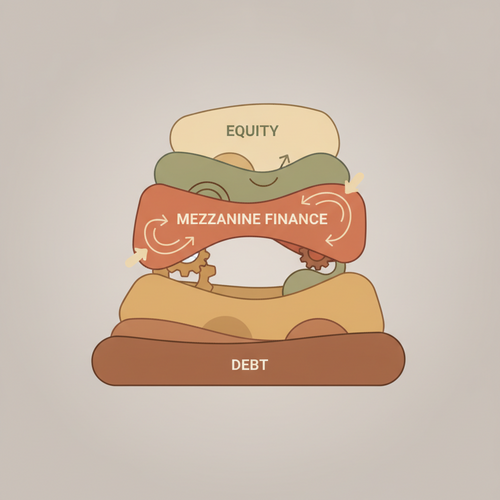
- Mezzanine financing bridges the gap between senior debt and equity, offering unique capital structure flexibility.
- Strategic deployment of mezzanine facilities can significantly impact a firm’s Weighted Average Cost of Capital (WACC).
- Optimizing WACC through tailored capital structures enhances enterprise valuation and investor returns.
The Anatomy of Corporate Capital Structures
Understanding a firm’s capital structure is fundamental to corporate finance. It represents the specific mix of debt and equity used to fund operations. This strategic allocation dictates financial leverage and risk profiles.
Traditional capital structures typically feature senior secured debt, subordinated debt, preferred equity, and common equity. Each layer carries distinct risk-return characteristics. Senior debt holds priority in repayment during liquidation events.
Equity, conversely, represents ownership and carries the highest risk. However, it also offers unlimited upside potential. The interplay between these components is critical for valuation.
Mezzanine Financing Facilities: A Hybrid Modality
Mezzanine financing occupies a unique position within the capital stack. It blends characteristics of both debt and equity instruments. This hybrid nature provides flexibility for growing enterprises.
Characteristically, mezzanine debt is subordinated to senior secured debt. However, it ranks above common and preferred equity. Its repayment priority is thus intermediate.
Often, mezzanine facilities incorporate an “equity kicker.” This component grants lenders an equity upside participation. Common forms include warrants, options, or conversion rights. The equity kicker aligns lender and borrower incentives.
Coupon rates on mezzanine debt are typically higher than senior debt. This reflects the increased subordination risk. However, it is generally lower than the cost of pure equity.
Expert Insight: “Practitioners observe that mezzanine capital is particularly attractive for firms requiring growth capital without significant equity dilution. It provides a non-bank financing avenue, often with fewer restrictive covenants.”
For a deeper dive into mezzanine finance, refer to Investopedia’s Mezzanine Financing definition.
Key Characteristics of Mezzanine Instruments
- Subordination: Always junior to senior secured debt.
- Higher Yield: Compensation for increased risk compared to senior lenders.
- Equity Participation: Often includes warrants or conversion features.
- Flexibility: Terms are highly customizable to borrower needs.
- Longer Maturities: Typically features longer repayment periods than traditional bank loans.
- Limited Covenants: Generally fewer and less stringent covenants than senior debt.
Strategic Rationale and Use Cases for Mezzanine Debt
Firms deploy mezzanine financing for various strategic objectives. It serves as a potent tool for growth, acquisitions, and recapitalizations. Its non-dilutive nature is a primary appeal.
Growth capital for market expansion or product development is a common use case. Mezzanine facilities enable rapid scale-up without immediate equity issuance. This preserves existing shareholder control.
Leveraged buyouts (LBOs) frequently utilize mezzanine tranches. These facilities bridge funding gaps between senior debt and equity contributions. They enhance transaction leverage.
Management buyouts (MBOs) also benefit from mezzanine capital. It provides management teams with the necessary funding. This allows them to acquire ownership stakes.
Recapitalizations can involve mezzanine financing to optimize the capital structure. It can replace more expensive equity or less flexible debt. This improves financial efficiency.
Mezzanine financing can fund capital expenditures (CapEx) for strategic initiatives. It supports significant investments without relying on public markets. This maintains operational autonomy.
Impact of Mezzanine Capital on WACC Calculations
The Weighted Average Cost of Capital (WACC) is a critical metric. It represents the average rate of return a company expects to pay to finance its assets. WACC is a key discount rate for valuation.
Introducing mezzanine financing into the capital structure alters WACC. Its cost typically falls between traditional debt and equity. This influences the overall financing cost.
The cost of mezzanine debt comprises its cash coupon and the value of its equity kicker. Accurately valuing the equity component is crucial. It directly impacts the effective cost of capital.
Mezzanine debt can lower WACC compared to relying solely on expensive equity. It provides a tax-deductible interest component. This reduces the after-tax cost of debt.
However, excessive mezzanine debt can increase financial risk. This can elevate the cost of equity and senior debt. A judicious balance is paramount for WACC optimization.
For an in-depth understanding of WACC, consult Investopedia’s Weighted Average Cost of Capital (WACC) guide.
Calculating the Cost of Mezzanine Capital
The explicit cost of mezzanine debt includes its interest payments. However, the implicit cost of the equity kicker must also be quantified. This requires careful financial modeling.
One approach values the equity kicker using option pricing models. The Black-Scholes model can estimate warrant or option values. This converts the equity upside into a current cost.
The total cost then becomes the sum of the cash interest and the amortized value of the equity kicker. This comprehensive cost is integrated into the WACC formula. It provides a holistic view.
Optimizing WACC Through Capital Structure Refinements
Optimizing WACC is a continuous process for financial managers. It involves strategically balancing debt and equity components. The goal is to minimize the cost of capital for a given risk level.
Mezzanine financing offers a powerful lever for WACC optimization. It allows firms to tap into a capital source more affordable than equity. Yet, it avoids the stringent covenants of senior debt.
Finding the optimal capital structure involves empirical analysis. Firms assess the marginal cost of each financing source. They also consider the impact on enterprise value.
Excessive leverage can increase the likelihood of financial distress. This raises the cost of both debt and equity. A curvilinear relationship often exists between leverage and WACC.
Management teams must consider their specific business risk profile. Industry norms and prevailing market conditions also influence optimal capital structure decisions. Dynamic adjustments are often necessary.
Risk-Return Dynamics and Covenant Considerations
While attractive, mezzanine financing carries specific risks. Its subordinated nature places lenders at higher risk of loss. This is particularly true in default scenarios.
For borrowers, mezzanine facilities introduce interest rate risk. Variable rate components can impact future cash flows. Managing this exposure is crucial.
Covenants in mezzanine agreements are typically less restrictive than senior debt. However, they are present and must be understood. These often relate to financial performance metrics.
Common covenants include debt-to-EBITDA ratios or minimum interest coverage. Breach of these covenants can trigger accelerated repayment or equity conversion. Diligence is paramount.
From a lender’s perspective, the equity kicker mitigates some downside risk. It offers participation in the company’s growth. This aligns interests over the investment horizon.
Market Warning: “In analyzing recent market shifts, financial advisors emphasize the need for robust stress testing. Ensure the firm’s cash flow generation can service mezzanine obligations under adverse economic conditions.”
Market Perspectives and Investment Trends
The mezzanine finance market has evolved significantly. It has become a crucial component of private capital markets. Demand stems from both borrowers and institutional investors.
Institutional investors, such as pension funds and insurance companies, favor mezzanine. It offers attractive yields compared to traditional fixed income. It also provides equity upside.
Market trends indicate a growing sophistication in mezzanine structures. Bespoke solutions are increasingly common. These cater to highly specific corporate needs.
Macroeconomic headwinds or tailwinds influence deal flow. During periods of tight credit, mezzanine funding becomes more vital. It fills gaps left by cautious senior lenders.
The competitive landscape among mezzanine providers is also intensifying. This can lead to more favorable terms for borrowers. However, due diligence remains essential.
Conclusion
Structured corporate capital, particularly through mezzanine financing facilities, offers potent avenues for WACC optimization. This hybrid instrument bridges the gap between traditional debt and equity. It provides flexible capital for growth, acquisitions, and recapitalizations. Judicious integration of mezzanine debt can significantly lower a firm’s overall cost of capital. It simultaneously preserves equity and minimizes dilution for existing shareholders. However, a thorough understanding of its risk-return profile and covenant implications is essential. Do you believe your current capital structure fully optimizes your enterprise valuation?