
Executive Summary
- Student Loan Asset-Backed Securities (SLABS) represent a critical segment of structured finance.
- Yield spread analysis provides crucial insights into pricing, risk premiums, and investor appetite.
- These instruments exert significant macroeconomic liquidity implications, influencing funding costs and financial system stability.
Understanding Student Loan Asset-Backed Securities (SLABS)
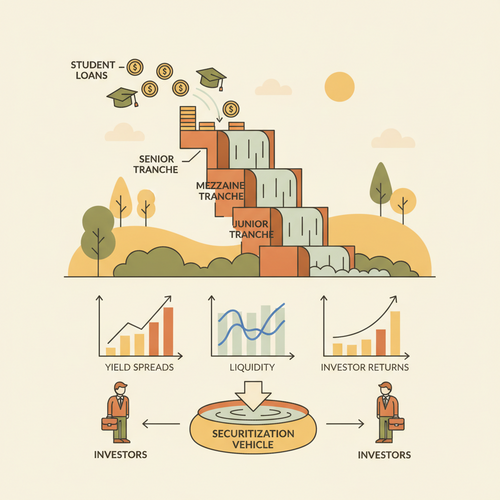
Student Loan Asset-Backed Securities (SLABS) are a specialized type of asset-backed security. They are collateralized by a pool of student loans. This securitization process transforms illiquid loans into tradable debt instruments. Investors gain exposure to the underlying loan cash flows. These cash flows typically consist of principal and interest payments. SLABS offer diversification benefits within fixed-income portfolios. Their market structure involves various tranches. Each tranche carries distinct risk and return profiles.
The primary categories of SLABS include Federal Family Education Loan Program (FFELP) loans. These are government-guaranteed. The other major category is private student loans. Private loans carry higher credit risk. Their performance depends entirely on borrower solvency. Understanding the distinction is paramount for investors. This influences credit ratings and pricing significantly. The securitization process involves complex legal structures. Special Purpose Vehicles (SPVs) are commonly employed.
The Securitization Process: From Loans to Marketable Securities
The securitization process begins with loan origination. Lenders extend student loans to qualified borrowers. These loans are then aggregated into a large pool. An issuer, often a financial institution, purchases this pool. They then transfer these assets to a Special Purpose Vehicle (SPV). The SPV issues various classes of notes, or tranches. Each tranche has different seniority and payment priorities. Senior tranches typically have lower risk. They offer correspondingly lower yields. Junior or equity tranches absorb initial losses. They offer higher potential returns.
Credit enhancement mechanisms are integral to SLABS. These protect investors against potential defaults. Common enhancements include overcollateralization. Excess spread and reserve accounts are also utilized. Subordination structures dictate loss allocation. The presence of government guarantees in FFELP loans is a significant enhancement. These guarantees mitigate default risk substantially. This makes FFELP SLABS generally safer. Private SLABS rely more heavily on structural enhancements.
Yield Spread Analysis in SLABS: Deconstructing Premiums
Yield spread analysis is fundamental to SLABS valuation. It quantifies the additional yield investors demand. This is over a benchmark interest rate. The spread compensates for various risks. These include credit risk, liquidity risk, and prepayment risk. Benchmark rates have primarily shifted to SOFR from LIBOR. This transition impacts pricing models. Understanding this dynamic is crucial for accurate valuation.
Several factors drive SLABS yield spreads. The credit quality of the underlying loan pool is paramount. Higher default rates widen spreads. Prepayment speeds also influence yield. Faster prepayments can reduce interest income for investors. Liquidity of the SLABS market segment affects spreads. Less liquid securities command higher spreads. Broader market sentiment also plays a significant role. Economic outlook shifts investor risk appetites.
Key Drivers of Yield Spread Variability
- Credit Risk: The probability of borrower default. FFELP loans carry minimal credit risk due to federal guarantees. Private loans exhibit substantial credit risk.
- Liquidity Risk: The ease of selling the security without significant price concession. Less liquid tranches demand higher spreads.
- Prepayment Risk: The uncertainty regarding the timing of loan repayments. This impacts average life and duration.
- Market Benchmarks: The reference rate (e.g., SOFR). Changes in its trajectory directly influence floating-rate SLABS.
- Investor Demand: Supply and demand dynamics for specific SLABS tranches. Strong demand compresses spreads.
- Servicer Performance: The effectiveness of loan servicers in collecting payments. Poor servicing can increase defaults.
Expert Insight: “In analyzing recent market shifts, the divergence between FFELP and private SLABS spreads has become more pronounced. This reflects growing investor scrutiny of underlying credit quality and macroeconomic resilience.”
Macroeconomic Liquidity Implications of SLABS
SLABS play a vital role in broader financial market liquidity. They transform illiquid student loans into investable assets. This enhances capital formation for educational lending. It also provides institutional investors with diverse investment opportunities. The scale of the SLABS market influences overall market depth. It contributes to the efficient allocation of capital.
Central bank policies significantly impact SLABS liquidity. Quantitative easing (QE) programs inject liquidity into markets. This can compress spreads across asset classes. Conversely, quantitative tightening (QT) withdraws liquidity. This often leads to wider spreads. The Federal Reserve’s stance on interest rates is also critical. Higher rates can increase funding costs for originators. This impacts issuance volumes. The availability of capital for new student loans directly relates to SLABS market function.
Systemic Risk and Financial Stability Considerations
The aggregate volume of outstanding student loan debt is substantial. Its securitization introduces systemic risk elements. A significant increase in defaults could impact SLABS performance. This might cascade through financial markets. The interconnectedness of securitized products is a concern. Regulators monitor these exposures closely. Stress testing of financial institutions includes SLABS portfolios. This assesses potential vulnerabilities. Maintaining market transparency is essential for stability.
From an operational standpoint, the role of government programs is key. The U.S. Department of Education holds a vast portfolio of student loans. Policy changes regarding loan forgiveness or repayment plans have ripple effects. These changes alter underlying loan performance. This impacts existing SLABS tranches. Investors must continually assess policy risk. This is particularly true for FFELP guarantees. Future government actions could shift market dynamics.
Regulatory Framework and Market Evolution for SLABS
The regulatory landscape for SLABS has evolved considerably. Post-2008 crisis reforms aimed to enhance market transparency. The Dodd-Frank Act introduced significant changes. Risk retention rules mandated that securitizers retain a portion of the credit risk. This aligned issuer and investor incentives. It aimed to discourage irresponsible lending practices. These regulations altered issuance strategies.
The transition from LIBOR to SOFR presented operational challenges. Financial institutions had to update contracts and models. This ensured smooth continuity for floating-rate SLABS. Ongoing regulatory oversight focuses on consumer protection. It also addresses potential market abuses. The Consumer Financial Protection Bureau (CFPB) actively monitors student loan servicing. Their actions impact servicer compliance. This influences asset performance directly.
Impact of Policy Shifts on SLABS Issuance and Performance
Policy changes have profoundly impacted SLABS issuance. The termination of the FFELP program in 2010 was a major turning point. This shifted new federal loan origination to direct lending. Existing FFELP SLABS continue to perform. New FFELP SLABS issuance effectively ceased. Private SLABS have since become the dominant form of new issuance. However, their volume remains sensitive to economic conditions. Federal student loan moratoriums also impacted cash flows. Investors had to model these temporary disruptions carefully. The long-term implications are still being assessed.
Technological advancements also shape the SLABS market. Data analytics and AI improve credit risk modeling. This enhances pricing accuracy. Blockchain technology could potentially streamline securitization processes. It offers greater transparency. These innovations might reduce issuance costs. They could attract new investor cohorts. However, integration complexities remain a hurdle.
Investor Considerations and Due Diligence in SLABS
Investors must conduct rigorous due diligence on SLABS. This involves scrutinizing the underlying loan characteristics. Loan origination standards are crucial. Borrower demographics and credit scores provide insight. Servicer quality and track record are equally important. Effective servicing minimizes defaults. It maximizes recovery rates. Understanding the legal structure of the SPV is also vital.
Quantitative analysis forms the bedrock of SLABS investment. Investors evaluate projected prepayment speeds. Default rates under various stress scenarios are modeled. Cash flow waterfalls for each tranche require careful examination. Sensitivity analysis helps assess exposure to interest rate fluctuations. It also models changes in credit performance. Comparing current spreads to historical averages can reveal mispricing. This informs investment decisions.
Assessing Credit Enhancement and Tranche Performance
Evaluating credit enhancement levels is critical. Overcollateralization provides a buffer against losses. Reserve accounts offer additional liquidity support. The thickness of junior tranches indicates loss absorption capacity. Investors analyze the subordination hierarchy thoroughly. This determines their position in the payment waterfall. A deep understanding of these mechanisms is essential. It enables accurate risk assessment for each tranche.
Performance metrics include delinquency rates and default rates. These are monitored against historical benchmarks. Cumulative loss projections guide portfolio management. Weighted Average Life (WAL) provides duration insight. Effective yield calculations incorporate all cash flow assumptions. Market participants leverage sophisticated analytical tools. These tools model complex SLABS structures. They project future performance under varied economic conditions.
Future Outlook and Emerging Trends in Student Loan Securitization
The future of student loan securitization holds dynamic shifts. Policy debates around student debt relief continue. These discussions create uncertainty for investors. The macroeconomic environment also presents challenges. Inflationary pressures and rising interest rates impact borrower repayment capacity. They also affect funding costs for originators. These factors will shape future issuance volumes. They also influence pricing dynamics across tranches.
Environmental, Social, and Governance (ESG) factors are gaining prominence. Investors increasingly consider the social impact of their holdings. This includes the accessibility and affordability of education loans. The sustainability of repayment burdens is a key focus. Ethical lending practices are being scrutinized more closely. SLABS products incorporating ESG criteria might emerge. These could attract new segments of capital. They would need robust measurement frameworks.
Innovation and Adaptation in a Changing Landscape
Technological innovation continues to advance. AI-driven credit scoring models offer enhanced predictive power. Digital platforms streamline loan servicing and collection. These improvements can lead to more efficient markets. They might reduce operational costs. The potential for tokenization of debt remains an exploratory area. This could democratize access to securitized products. However, regulatory clarity is still developing.
Market participants are also exploring new structures. Bespoke SLABS deals cater to specific investor appetites. The role of private credit funds is expanding. These funds are increasingly active in non-bank lending. They could become significant players in private student loan securitization. Adapting to these evolving trends is crucial. It ensures continued market functionality and growth. Investors must remain agile in their strategies.
For further technical understanding of financial instruments, refer to Investopedia’s explanation of Asset-Backed Securities. For in-depth regulatory insights into securitization, the SEC’s press release on risk retention rules provides foundational context.
Conclusion
Student Loan Asset-Backed Securities represent a sophisticated asset class. Their yield spread analysis demands meticulous attention to detail. Understanding underlying credit risk is paramount. Assessing macroeconomic liquidity implications provides broader market context. These instruments are integral to educational finance. They offer unique risk and return profiles. Investors navigating this complex landscape require deep expertise. They must continuously adapt to evolving market conditions. Staying informed on policy shifts is crucial. Do you possess the analytical frameworks required to capitalize on SLABS market opportunities?