
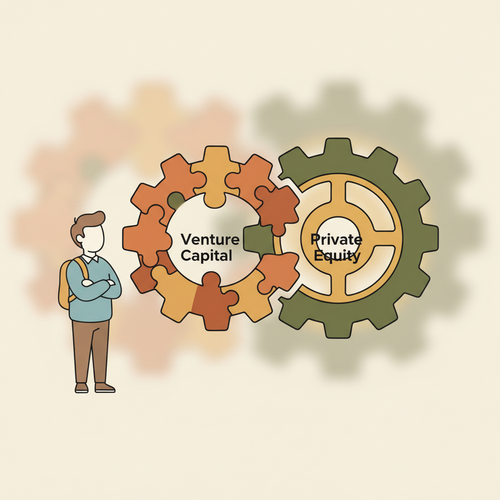
Welcome, future finance enthusiasts! Ever heard terms like “Venture Capital” or “Private Equity” thrown around and felt a little lost? You are definitely not alone; these fields can seem complex from the outside. However, understanding the core differences between Venture Capital vs Private Equity is crucial for anyone pursuing a career in high finance. This guide will break down the fundamental distinctions in simple, easy-to-digest language. Consequently, you will gain a clear picture of how these investment powerhouses operate in the real world.
Navigating the world of investments can feel like learning a new language, filled with jargon designed to confuse. But don’t worry, as we will cut through the technical noise. Whether you dream of starting a high-growth company or working as a financial analyst, this Venture Capital vs Private Equity comparison is your starting point. Therefore, let’s begin your journey toward financial literacy by exploring how these firms fuel the global economy.
Quick Summary: Your Guide to VC vs. PE
- 🚀 Venture Capital (VC) invests in early-stage, high-growth startups, often with big risks and big potential returns.
- 💰 Private Equity (PE) targets more mature, established companies, aiming to improve their operations and sell them for profit.
- 🎯 Key Difference: In the Venture Capital vs Private Equity battle, VC is about funding innovation, while PE is about optimizing existing businesses.
What is Venture Capital (VC)? The Innovation Engine
Imagine a brilliant startup founder with an amazing idea but no money to build it. This is exactly where Venture Capitalists step in to save the day. VC firms provide essential capital to fledgling companies, typically in exchange for an equity stake. Furthermore, these investments usually go into businesses with high growth potential, often in technology, biotech, or disruptive industries.
VC funding acts as a lifeline for innovation, fueling tomorrow’s giants like Google or Amazon in their early days. Because many startups fail, it remains a high-risk, high-reward game. However, a few successful bets can lead to astronomical returns for the investors. When analyzing Venture Capital vs Private Equity, remember that VCs are looking for exponential growth rather than steady, predictable profits.
Key Characteristics of Venture Capital:
- 💡 Early-Stage Focus: VCs typically invest in seed, Series A, B, and C rounds before a company goes public.
- 📈 Growth-Oriented: They prioritize market share and rapid scaling over immediate dividends.
- 🤝 Active Involvement: Investors often provide mentorship and strategic guidance to founders to ensure success.
- 🌐 Sector Specific: Many VCs specialize in high-tech industries like AI, fintech, or health tech.
Pro Tip: Think of Venture Capital as the “Dragon’s Den” for startups. You are pitching your future potential, not your past performance. Success in this field often means completely disrupting an entire industry with a new product or service.
What is Private Equity (PE)? The Business Doctors
Now, shift your focus from brand-new ideas to established businesses that might be underperforming or need a strategic overhaul. This is the primary playground of Private Equity. PE firms acquire significant, and often controlling, stakes in mature companies. Consequently, their goal isn’t just to provide cash; it is to actively improve the company’s operations, management, or market position.
In the Venture Capital vs Private Equity landscape, PE firms act like business doctors. They diagnose internal issues and implement aggressive treatments to make a company more valuable. This often involves anything from streamlining complex supply chains to expanding into untapped international markets. After a few years of “treatment,” they aim to sell the improved company for a substantial profit.
Core Features of Private Equity:
- 🏢 Mature Companies: They target established businesses, often with stable and predictable cash flows.
- 🔄 Operational Improvement: The focus lies on efficiency, cost-cutting, and long-term strategic growth.
- 💰 Leveraged Buyouts (LBOs): Firms frequently use borrowed money (debt) to fund these large acquisitions.
- ⏳ Medium-Term Horizon: Investors typically hold these companies for 3 to 7 years before exiting.
Direct Comparison: Venture Capital vs Private Equity
While both fields involve private investment, their approaches and targets couldn’t be more distinct. Understanding these differences is fundamental for any finance student. Therefore, we have compiled a quick comparison to highlight the main drivers of each industry:
| Feature | Venture Capital (VC) | Private Equity (PE) |
|---|---|---|
| Company Stage | Early-stage startups, pre-revenue. | Mature, established companies. |
| Investment Goal | Achieve massive growth and innovation. | Operational efficiency and market consolidation. |
| Ownership Stake | Minority stake, but high influence. | Often majority or controlling stake. |
| Typical Funding | Pure equity financing. | Equity combined with significant debt (LBO). |
| Risk Profile | Very high (high failure rates). | Moderate to high (debt adds risk). |
| Time Horizon | Typically 5-10+ years. | Typically 3-7 years. |
Warning: Don’t confuse “private” with “small.” Both VC and PE deal with enormous sums of money. The “private” part simply means the investments are not traded on public stock exchanges like the NYSE. For more insights on market trends, you can visit Bloomberg or The Wall Street Journal.
Who Gets the Money? Target Companies Explained
The types of businesses that attract VC and PE are vastly different, mirroring their unique investment philosophies. VC funds often target disruptive technologies like renewable energy innovations or groundbreaking SaaS platforms. They are constantly looking for the “next big thing” that could redefine an entire market. Think of companies that are just starting to scale rapidly or solving problems in entirely new ways.
On the other hand, PE firms might acquire a struggling retail chain, a manufacturing company needing modernization, or a healthcare provider ready for expansion. They focus on value creation within an existing framework. Consequently, they often look for companies with predictable cash flows that can support the debt used in the acquisition. In the Venture Capital vs Private Equity debate, VC builds from scratch, while PE rebuilds for efficiency.
Why Should You Care? Your Future Career in Finance
For students, understanding Venture Capital vs Private Equity isn’t just an academic exercise; it opens doors to exciting career paths. Both fields are highly competitive but offer incredible rewards for those who succeed. If you are fascinated by innovation, entrepreneurship, and rapid growth, then Venture Capital might be your calling.
However, if you are drawn to strategic business operations, financial engineering, and transforming legacy companies, then Private Equity could be a perfect fit. Many finance roles, from junior analysts to senior portfolio managers, exist within these firms. Furthermore, you should consider exploring internships to get a real feel for the different cultures in each sector. Networking is absolutely key in these industries, so don’t be afraid to connect with professionals on LinkedIn.
Pro Tip: To stay ahead of the curve, regularly read the Harvard Business Review and Forbes. These resources provide deep dives into the strategies used by the world’s most successful PE and VC firms. Mastering these concepts now will give you a significant edge during job interviews.
Conclusion: Fuels for the Financial Future
You have now gained a solid grasp of the fundamental differences between Venture Capital vs Private Equity. One fuels the future of technology, while the other refines the present state of business. Both are crucial components of the modern financial landscape, driving global economic growth and continuous innovation. Whether you see yourself backing a tech giant or optimizing a legacy manufacturing business, these fields offer dynamic and challenging opportunities.
Your understanding today is the first step toward a powerful career tomorrow. As the economy evolves, the lines between these fields sometimes blur, but their core missions remain distinct. Consequently, the more you learn now, the better prepared you will be to navigate your professional choices in the future. Which path sounds more exciting to you, and why?