
Executive Summary
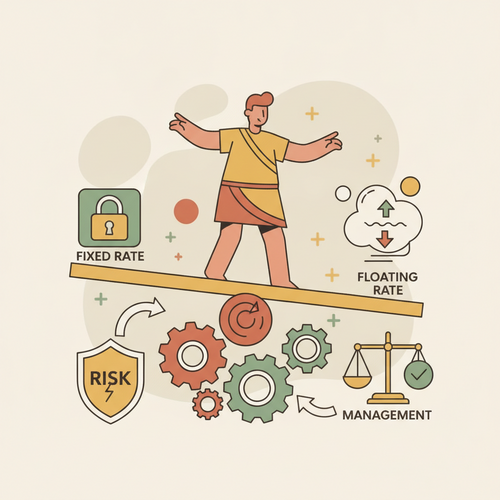
- Institutional credit arbitrage leverages discrepancies in fixed-to-floating rate markets.
- Graduate borrowers, managing substantial debt, face significant interest rate risk exposure.
- Sophisticated hedging strategies, particularly interest rate swaps, mitigate adverse rate movements.
Understanding Institutional Credit Arbitrage Dynamics
Credit arbitrage involves exploiting pricing inefficiencies across different debt instruments. This strategy seeks to generate alpha from market dislocations. Such opportunities often arise in the fixed income and derivatives markets. Institutional players actively pursue these complex scenarios.
For graduate borrowers, specifically those with substantial student loan portfolios, their debt often represents a significant long-term liability. These borrowers face unique challenges. Their financial profiles may resemble institutional entities more than retail consumers. Managing this exposure demands a sophisticated approach.
The core of credit arbitrage for this demographic lies in managing interest rate volatility. Graduate debt often features variable rates or offers refinancing into fixed options. Identifying optimal entry and exit points becomes crucial. This requires a granular understanding of market microstructure.
The Nuances of Fixed-to-Floating Rate Exposure
Graduate borrowers frequently encounter both fixed-rate and floating-rate debt structures. Floating-rate instruments, typically benchmarked against indices like SOFR, expose borrowers to rate hikes. Fixed-rate debt offers payment stability. However, it foregoes potential savings during rate declines.
An intricate risk assessment is paramount for long-term debt. Duration mismatch becomes a significant concern. Borrowers holding long-dated floating-rate obligations are especially vulnerable. Unexpected changes in monetary policy can severely impact cash flow. This necessitates proactive risk mitigation.
Understanding the current and projected interest rate regimes is vital. A hawkish central bank stance suggests increasing floating rate costs. Conversely, a dovish outlook might favor maintaining floating rate exposure. Strategic positioning depends on these macroeconomic forecasts.
Core Hedging Instruments: Interest Rate Swaps and Derivatives
Interest rate swaps represent a cornerstone of fixed-to-floating rate hedging. These over-the-counter (OTC) agreements exchange fixed-rate payments for floating-rate payments. They are executed on a notional principal amount. The underlying principal itself never changes hands.
The mechanics of plain vanilla swaps are straightforward. One party pays a fixed interest rate. The other party pays a floating rate. This effectively converts a borrower’s floating-rate liability into a fixed-rate obligation. It provides predictable cash outflows. This predictability is highly valued in financial planning.
Advanced derivative applications extend beyond basic swaps. Swaptions offer the right, but not the obligation, to enter into a swap. Caps limit upside exposure to floating rates. Floors protect against downside rate movements. These instruments provide tailored risk management solutions. Learn more about Interest Rate Swaps.
Expert Insight: “In analyzing recent market shifts, we observe heightened demand for longer-dated swaptions. This signals increased market uncertainty regarding future interest rate trajectories and a proactive stance by sophisticated borrowers to lock in future hedging optionality.”
Crafting Robust Hedging Strategies: A Multi-faceted Approach
Developing effective hedging strategies requires a dynamic perspective. Static positions, while offering initial stability, may become suboptimal. Market conditions evolve rapidly. A dynamic hedging approach adjusts derivative positions continually. It responds to changes in the yield curve and volatility.
Scenario analysis and stress testing are indispensable. These methodologies evaluate portfolio performance under adverse market conditions. They identify potential vulnerabilities. Understanding maximum probable loss is critical. This informs prudent risk-taking and capital allocation.
Leveraging macroeconomic indicators guides strategic decisions. Inflationary pressures often lead to higher rates. Employment data and GDP growth influence central bank policy. Integrating these factors into hedging models enhances foresight. It refines the timing of derivative transactions.
Operationalizing Hedging: Counterparty Risk and Collateral Management
Executing derivative strategies involves significant counterparty risk. This is the risk that the other party to a financial contract defaults. Mitigating this exposure is paramount. Collateralization agreements (CSAs) reduce this risk. They require posting margin based on market value fluctuations.
Regulatory frameworks impose strict compliance requirements. Regulations like Dodd-Frank and EMIR aim to reduce systemic risk. They mandate central clearing for many OTC derivatives. This adds layers of complexity and cost. Compliance is a non-negotiable aspect of institutional hedging.
Liquidity management within derivative portfolios demands constant vigilance. Margin calls can create significant cash flow demands. Sufficient liquid assets must be maintained. This prevents forced selling of other assets to meet obligations. Effective treasury management integrates hedging activities.
Understand Counterparty Risk better.
Impact of Benchmark Transitions: LIBOR to SOFR
The transition from LIBOR to SOFR has profoundly impacted the derivatives market. LIBOR’s cessation introduced significant challenges. Existing contracts required robust fallback provisions. This presented both operational hurdles and re-pricing complexities.
SOFR, a broad measure of the cost of borrowing cash overnight collateralized by Treasury securities, presents different characteristics. It is a secured rate. This differs from LIBOR’s unsecured nature. The basis risk between the two benchmarks is a key consideration. Hedging strategies must adapt to SOFR’s nuances.
Strategic implications for future hedging are extensive. New derivative contracts predominantly reference SOFR. Borrowers must understand SOFR-linked swap pricing. They must also account for any term SOFR conventions. This ensures accurate valuation and effective risk transfer. The transition demands proactive portfolio adjustments.
Advanced Considerations: Convexity Hedging and Duration Matching
Optimizing portfolio duration is central to advanced hedging. Duration measures a bond’s price sensitivity to interest rate changes. Matching the duration of liabilities with assets reduces interest rate risk. This ensures a stable net worth despite rate movements.
Convexity hedging addresses non-linear price-yield relationships. As interest rates change, duration itself changes. Convexity measures this rate of change. Positive convexity is generally desirable. It provides more price appreciation during rate declines than depreciation during rate rises. Managing convexity enhances portfolio robustness.
Managing non-parallel yield curve shifts further refines hedging. The yield curve does not always move uniformly. Twists and steepening or flattening can occur. Hedging only for parallel shifts leaves residual risk. Strategies involving multiple swap tenors address these more complex movements. This multi-faceted approach minimizes basis risk across the curve.
Conclusion
Navigating the complexities of institutional credit arbitrage requires profound expertise. Fixed-to-floating rate hedging is not merely a tactical maneuver. It is a strategic imperative for graduate borrowers with significant liabilities. Robust derivative strategies, coupled with astute risk management, offer substantial protection. They ensure financial stability amidst volatile market conditions. The shift to SOFR further underscores the need for adaptability. Continuous vigilance and sophisticated analysis remain critical. How will evolving macroeconomic landscapes shape your future hedging imperatives?