
Executive Summary
- Strategic structuring of high-yield tranches requires disciplined credit enhancement and robust waterfall mechanics.
- Illiquid market environments amplify structural friction, necessitating precise liquidity risk pricing and overcollateralization.
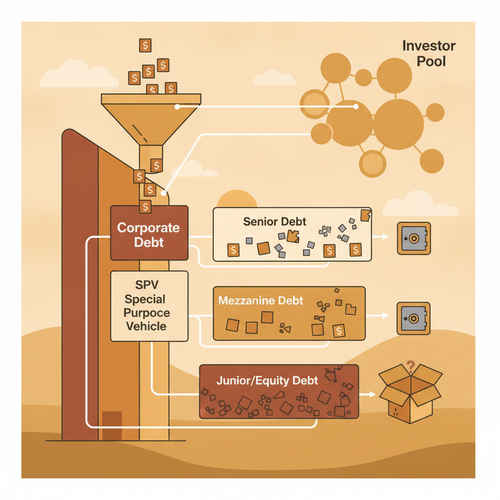
- Special Purpose Vehicles (SPVs) provide vital legal isolation to protect capital hierarchy across stress scenarios.
Mechanics of Corporate Debt Securitization in Illiquid Private Markets
Structured finance converts illiquid corporate obligations into negotiable capital market instruments. Securitization redistributes credit risk among distinct risk-profile investors. Originators aggregate corporate loans, middle-market debt, or trade receivables. These underlying assets form the primary collateral pool for structured transactions. Private debt markets often face severe secondary trading constraints. Illiquidity magnifies asset pricing volatility during broader economic downcycles.
Structuring high-yield tranches under these conditions demands rigorous financial engineering. In illiquid markets, asset pricing lacks continuous mark-to-market visibility. Underwriters must rely on fundamental credit analysis rather than exchange pricing. You must evaluate cash flow predictability across underlying corporate borrowers carefully. Proper asset selection determines transaction survival during systemic market shocks.
Diversification across non-correlated sectors mitigates localized default risk. For deep technical context on collateral pooling mechanics, review securitization fundamentals. Structured debt architectures isolate cash flows to satisfy institutional investor requirements. Sound origination standards prevent structural failure in private market environments.
Structural Waterfall Architecture and Risk Tranching Dynamics
Cash flow waterfalls dictate the priority of payment within structured vehicles. Sequential-pay structures prioritize senior noteholders above subordinated debt tiers. Scheduled interest and principal payments flow top-down through the capital structure. Senior tranches absorb losses only after junior tranches suffer total capital impairment. Equity tranches act as the primary loss-absorbing buffer within the deal structure.
Consequently, equity and mezzanine holders demand higher yields to compensate for first-loss exposure. High-yield subordinated tranches bridge the structural gap between equity and investment-grade debt. Structuring these middle-tier tranches requires balanced cash flow allocation rules. In illiquid settings, structural waterfall triggers must react dynamically to credit deterioration.
Principal redemption shifts from pro-rata to sequential distribution upon trigger breach. This mechanism locks cash flows within senior classes during acute market distress. Subordinated investors must account for structural lock-up risks before committing capital. Effective waterfall design ensures systemic resilience across shifting credit cycles.
Credit Enhancement Mechanisms for Subordinated Tranches
Credit enhancement protects noteholders against unexpected collateral pool default losses. Subordination serves as the primary internal credit enhancement framework. Additional internal mechanisms include overcollateralization and structural excess spread. Overcollateralization occurs when total collateral asset value exceeds issued note liabilities. The excess collateral margin absorbs initial principal loss write-downs.
Structuring engineers calibrate this protective margin based on historical pool default probability. Excess spread represents the difference between asset yields and liability coupons. The structure retains this excess spread to offset current-period interest shortfalls. Internal credit enhancements offer reliable protection to structured private debt transactions.
External credit enhancements provide secondary loss protection through external balance sheets. These mechanisms include financial guarantees, letters of credit, and cash collateral accounts. However, external enhancements increase transaction counterparty risk in illiquid environments. Internal structural buffers generally provide superior protection during acute market dislocation events.
Liquidity Risk Quantification and Illiquidity Premium Valuation
Illiquid debt instruments exhibit structural exit frictions and wide bid-ask spreads. Quantifying liquidity risk requires measuring asset liquidation timelines under market stress. Traditional cash flow models often understate true liquidity risk in private credit pools. You must incorporate dynamic haircuts into collateral valuation assumptions. Lower secondary market liquidity increases required tranche yield spreads significantly.
Expert Insight: In illiquid markets, recovery rates decay rapidly during default waves. Structuring teams must test structural triggers against simultaneous yield curve shifts and credit spread widening.
Investors demand an explicit illiquidity premium alongside standard credit risk compensation. Structuring teams calculate this illiquidity premium using structural cash flow simulation models. Yield calculations must reflect extended recovery horizons for defaulted portfolio assets. Delayed asset recovery timelines reduce effective internal rate of return metrics. Furthermore, refinancing risk increases when liability maturity walls approach without active secondary liquidity.
Comparative Structuring Matrix for High-Yield Securitization Vehicles
Different structured vehicles serve distinct asset classes and investor risk appetites. Understanding structural trade-offs is essential for optimized transaction design. The choice of vehicle impacts liquidity, yield, and credit enhancement requirements directly.
| Vehicle Type | Underlying Collateral | Typical Subordination Level | Primary Liquidity Risk | Target Tranche Yield |
|---|---|---|---|---|
| Collateralized Loan Obligations (CLO) | Broadly Syndicated Corporate Debt | 8% – 12% Equity Buffer | Moderate Secondary Spread Volatility | SOFR + 600 – 900 bps |
| Middle-Market CLO (MM-CLO) | Direct Lending Private Corporate Loans | 15% – 25% First Loss Buffer | High Secondary Asset Illiquidity | SOFR + 800 – 1200 bps |
| Asset-Backed Commercial Paper (ABCP) | Short-Term Trade Receivables | 5% – 8% Credit Enhancement | High Refinancing & Liquidity Frictions | Benchmark + 150 – 300 bps |
| Bespoke Private Debt Securitization | Distressed Corporate & Special Situations | 30% – 40% Subordinated Tier | Extreme Illiquidity & Workout Risks | 15.0% – 22.0% Fixed IRR |
Selecting the optimal vehicle depends on underlying pool credit quality. Middle-market structures require higher subordination due to lower asset liquidity. Equity buffers must withstand correlated defaults in concentrated private market segments. For a detailed breakdown of tranche structures, consult the guide on structured debt tranches. Precise structural alignment ensures durable transaction execution in illiquid financial environments.
Legal Isolation and Special Purpose Vehicle (SPV) Optimization
True sale bankruptcy remoteness forms the legal foundation of corporate securitization. The originator transfers underlying corporate receivables to an independent SPV entity. The SPV must remain strictly bankruptcy-remote from the originator’s balance sheet. Legal counsel issues formal true-sale and non-consolidation opinions to validate bankruptcy isolation. Without clean legal isolation, originator insolvency could freeze asset cash flows unexpectedly.
Court injunctions severely compromise timely interest payments to high-yield tranche holders. Cross-border SPV structuring introduces additional tax and regulatory considerations. Key financial jurisdictions offer specialized, tax-neutral corporate environments for asset-backed vehicles. Optimizing SPV legal architecture minimizes transaction-level tax leakages effectively.
Reduced tax friction preserves cash flow for high-yield tranche coupon distributions. Furthermore, governing transaction documentation must clearly define bankruptcy-remote operational constraints. Strict operating covenants prevent the SPV from incurring unauthorized external debt. Preserving structural legal integrity protects investor capital across complex restructuring scenarios.
Stress Testing Tranche Sensitivity under Adverse Macroeconomic Scenarios
Quantitative scenario analysis validates tranche resilience under extreme economic stress conditions. Robust risk models test cash flow durability against sudden default spikes. Analysts apply stress multipliers to baseline corporate default probability assumptions. Loss severity models simulate prolonged asset recovery and liquidation timelines. Macroeconomic shocks evaluate interest rate volatility, credit contraction, and sector weakness.
High-yield tranches experience rapid principal impairment when defaults cluster simultaneously. Sensitivity testing determines precise trigger thresholds for structural conversion events. A breach of overcollateralization coverage tests redirects interest flows to pay down senior debt notes. This dynamic cash sweep mechanism accelerates senior debt amortization immediately.
Consequently, subordinated noteholders face temporary coupon deferral during stress periods. Accurate stress testing ensures high-yield tranches are priced appropriately for deferral risk. Dynamic financial modeling builds institutional investor confidence during market turmoil.
Strategic Execution and Active Servicing in Private Credit Deals
Executing high-yield corporate debt securitizations requires seamless stakeholder coordination. Originators, structural arrangers, rating agencies, and institutional investors must align incentives. Rating agencies evaluate credit enhancement adequacy through proprietary quantitative stress models. Institutional investors analyze structural covenants, servicing capabilities, and liquidity provisions thoroughly.
Clear communication regarding structural risks facilitates efficient primary market transaction pricing. Post-issuance active servicing directly impacts long-term collateral performance and liquidation yields. Special servicers must manage delinquent corporate loans proactively within the portfolio. Early intervention strategies reduce ultimate loss severity during complex corporate debt restructurings.
In illiquid private asset classes, workout expertise protects high-yield tranche capital. Transparent monthly investor reporting maintains secondary market credibility throughout the vehicle lifecycle. Disciplined deal administration ensures structural compliance and optimizes total risk-adjusted returns.
Conclusion
Corporate debt securitization remains a powerful instrument for unlocking capital efficiency. Structuring high-yield tranches in illiquid environments requires disciplined risk management. Financial engineers must balance attractive yield generation with robust structural protection mechanisms. Subordination, overcollateralization, and legal isolation safeguard investor capital against unexpected economic shocks. Rigorous stress testing ensures long-term tranche durability during market illiquidity.
How are you adjusting your debt structuring strategies to navigate current private credit market illiquidity?