
Executive Summary
- The tri-party repo market is crucial for institutional cash collateralization and systemic liquidity.
- It provides robust mechanisms for managing counterparty credit exposure through third-party intermediation.
- Operational efficiencies and evolving regulatory frameworks continually shape its market dynamics and risk profiles.
The Tri-Party Repo Framework: A Structural Overview
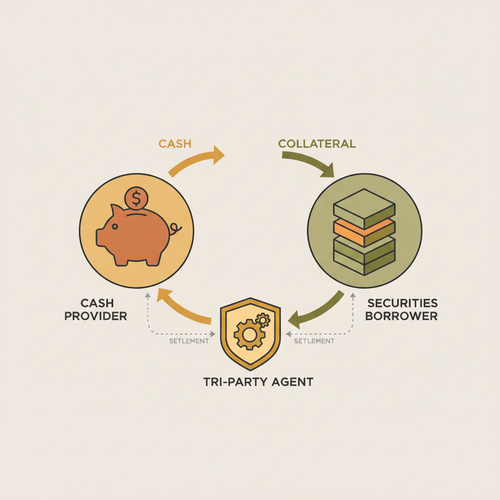
Tri-party repurchase agreements represent a cornerstone of short-term funding markets. This sophisticated mechanism involves three distinct parties. These include the cash provider, the securities borrower, and a designated tri-party agent. The agent, often a large custodian bank, facilitates the transaction. They manage the collateral, ensuring its proper valuation and segregation. This structure significantly mitigates operational burdens for both principals. It also enhances transaction security. Market participants leverage tri-party repo for efficient liquidity management. It provides critical access to secured funding. This framework underpins vast volumes of daily market activity.
The tri-party agent’s role extends beyond mere custody. They handle intricate collateral selection. This includes eligibility screening and substitution processes. Daily valuation and margin maintenance are also their responsibility. This minimizes potential disputes between transacting parties. It ensures that collateral values remain appropriate. The agent’s infrastructure provides a standardized platform. This standardisation is vital for high-volume, low-margin transactions. It supports institutional investors seeking optimal cash deployment. Simultaneously, it allows dealers to finance their securities inventories effectively.
Enhancing Institutional Cash Collateralization Efficiency
Institutional investors prioritize secure and efficient cash deployment. Tri-party repo offers a highly liquid avenue. It allows for collateralization with high-quality assets. These often include government bonds or agency securities. The underlying collateral is held in a segregated account. This segregation is managed by the tri-party agent. It significantly reduces asset commingling risk. Cash providers gain direct exposure to high-grade collateral. This structure enhances portfolio managers’ confidence. It supports conservative investment mandates. The automated collateral management by the agent is key.
Operational efficiency is a major draw for cash investors. The tri-party agent manages the mechanics. This includes collateral allocation, substitution, and mark-to-market adjustments. These processes are largely automated. This reduces the administrative burden on internal teams. It frees up resources for strategic analysis. The efficiency also translates into faster settlement. This is crucial for optimizing intraday liquidity. Effective cash collateralization ensures robust risk management. It provides a reliable income stream for institutions. Furthermore, it offers flexibility in tenor. This ranges from overnight to longer durations.
Mitigating Counterparty Credit Exposure Risks
Counterparty risk remains a primary concern in financial markets. Tri-party repo directly addresses this challenge. The agent holds collateral on behalf of both parties. This structural safeguard protects the cash provider. In a default scenario, the agent can liquidate the collateral. This process occurs without direct intervention from the defaulting party. Robust collateral haircuts are applied. These reduce the market value of the collateral. This provides a buffer against price fluctuations. It protects against potential liquidation losses. Regular mark-to-market adjustments are critical. They ensure collateral adequacy daily. This proactive management minimizes potential losses.
The tri-party agent performs ongoing credit monitoring. This includes monitoring both the borrower and the collateral. Specific eligibility criteria apply to collateral. These criteria are often agreed upon in master repurchase agreements. These agreements, like the Master Repurchase Agreement (MRA), define legal obligations. Diversification of collateral types further reduces concentration risk. Financial institutions continually refine their risk frameworks. They incorporate stress testing scenarios. These evaluate potential market dislocations. Such analysis ensures the tri-party repo mechanism remains resilient. It effectively manages systemic vulnerabilities.
Expert Insight: “Effective collateral optimization within the tri-party repo framework hinges on advanced analytical tools. These tools allow institutions to dynamically manage asset encumbrance, balancing liquidity needs with regulatory capital constraints.”
Liquidity Transformation and Market Stability Implications
The tri-party repo market acts as a vital liquidity transformer. It facilitates the flow of short-term cash. This occurs between various market participants. These include money market funds, banks, and corporations. The market provides a critical funding source for dealers. They use it to finance their securities inventories. This contributes significantly to overall market stability. Disruptions in this market can have broad implications. The 2008 financial crisis highlighted its systemic importance. Authorities have since implemented robust regulatory measures. These measures aim to enhance transparency and reduce contagion risk. Prudential regulation focuses on resilience.
Regulatory frameworks like Basel III emphasize funding stability. The Liquidity Coverage Ratio (LCR) and Net Stable Funding Ratio (NSFR) impact repo usage. These rules encourage stable, long-term funding sources. They also influence the types of collateral accepted. Higher-quality liquid assets (HQLA) are preferred. This shift impacts dealer balance sheets. It also affects their ability to intermediate. Central clearing counterparties (CCPs) are also becoming more prevalent. While less common in tri-party repo directly, their principles influence market structure. They aim to reduce bilateral counterparty exposures. Policymakers continually assess the market’s role. They monitor its capacity to absorb shocks. This ensures ongoing financial system resilience.
Operational Efficiencies and Technological Advancements
The inherent design of tri-party repo champions operational efficiency. Automated systems manage the entire lifecycle of a trade. This includes matching, collateral allocation, and settlement. Post-trade services also benefit from automation. These cover reporting and reconciliation. The reduction in manual intervention is significant. It minimizes operational risk and processing errors. Straight-through processing (STP) rates are exceptionally high. This translates into cost savings for participants. It also ensures rapid execution and settlement. The agent’s infrastructure acts as a single point of truth. This provides transparency for both parties. It simplifies auditing and compliance efforts. This efficiency makes large-scale transactions feasible.
Recent technological advancements promise further enhancements. Distributed Ledger Technology (DLT) shows potential for repo markets. It could revolutionize collateral management and settlement. Smart contracts might automate many manual processes. This would further reduce settlement times. Real-time visibility of collateral pools could improve. This would enhance liquidity management capabilities. However, adoption faces significant hurdles. These include scalability, interoperability, and regulatory acceptance. The transition to new technologies requires substantial investment. It also demands careful coordination across the industry. Despite challenges, the drive for innovation continues. It aims to make the tri-party repo market even more robust and efficient. Collateral management platforms are continually evolving.
Regulatory Scrutiny and Evolving Market Practices
Post-crisis regulatory reforms have profoundly shaped the tri-party repo market. The Dodd-Frank Act in the U.S. and EMIR in Europe introduced new oversight. These regulations aimed to increase transparency. They sought to reduce systemic risk. Mandatory reporting requirements were a key component. These provide regulators with greater insight. They monitor market activity and exposure concentrations. These measures enhance market stability. They also impose increased compliance costs on participants. The move towards standardized documentation is also evident. This reduces legal and operational ambiguities. Regulators focus on ensuring robust risk controls. They scrutinize collateral valuation practices. Haircut methodologies are also under review. These efforts strengthen market integrity.
Market participants have adapted to this evolving landscape. They have enhanced their internal risk management systems. They also invest in better data analytics capabilities. The emphasis on high-quality collateral has intensified. Banks face stricter capital and liquidity requirements. This influences their funding strategies. It also impacts their willingness to lend. The role of central banks has expanded. They often intervene to stabilize repo markets during stress. This underscores the market’s critical function. Ongoing dialogue between regulators and industry stakeholders is vital. This collaboration ensures adaptable and effective policies. It balances stability objectives with market functionality. This dynamic environment necessitates continuous vigilance.
Strategic Portfolio Management in Tri-Party Repo
Sophisticated investors utilize tri-party repo for strategic portfolio management. It offers an efficient avenue for generating yield on surplus cash. This happens while maintaining high liquidity. Diversification of counterparty exposure is paramount. Allocating cash across multiple, creditworthy counterparties reduces concentration risk. Portfolio managers carefully assess haircuts. They analyze different collateral types. This informs their risk-adjusted return decisions. Optimization models help determine optimal cash allocation. These models consider liquidity, yield, and risk parameters. The ability to substitute collateral offers flexibility. It allows adaptation to changing market conditions. This dynamic approach maximizes capital efficiency.
Returns in the tri-party repo market are typically modest. However, they are highly reliable for low-risk cash deployment. The market offers an attractive alternative to traditional money market instruments. It provides secured lending opportunities. Institutions can manage their funding costs effectively. This occurs by utilizing available collateral. The market supports bespoke transaction structures. These cater to specific liquidity profiles or investment mandates. Engaging with reputable tri-party agents is crucial. Their operational excellence underpins successful execution. Strategic engagement ensures regulatory compliance. It also optimizes financial outcomes for all participants. This market demands continuous monitoring and adaptive strategies.
Conclusion
The tri-party repo market remains indispensable. It underpins financial market liquidity. It facilitates institutional cash collateralization. The framework effectively manages counterparty risk exposures. Its operational efficiencies are significant. Regulatory oversight continues to evolve. This ensures ongoing market resilience. Technological innovations promise further enhancements. Navigating this complex ecosystem requires expertise. It demands robust risk management frameworks. Strategic engagement with tri-party agents is critical. Are you fully optimizing your firm’s cash collateralization strategies within this dynamic market?